





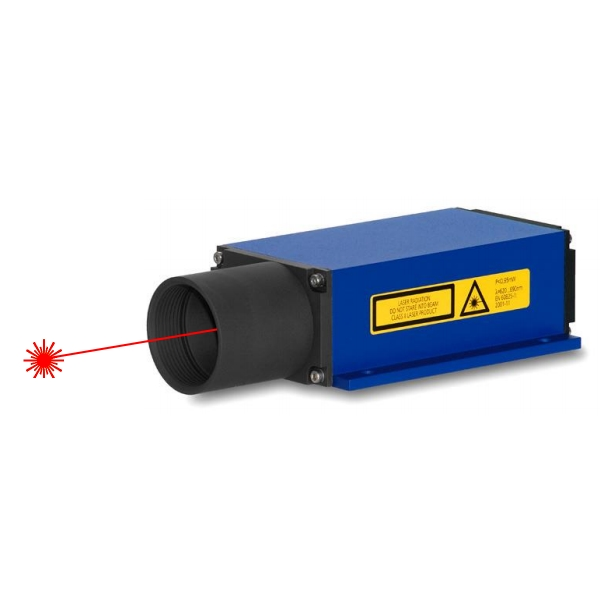
Non-contact distance measurement with LASER distance sensors makes it possible to detect distances, positions and levels quickly and accurately, even on moving, hot or hard-to-reach objects, without touching the target.
- Non-contact: nothing touches the target
- LASER beam: localized, accurate measurement
- Wide range: from a few cm to hundreds of meters
- Accuracy: down to the millimeter
- Moving or hot objects: safe measurement from a distance
- Industrial outputs: analog, serial, network
- Applications: level, position, clearances, safety
When touching the object is not possible or not convenient, because it is moving, hot, fragile or far away, distance has to be measured without contact. Industrial LASER distance sensors meet this need by projecting a light beam onto the target and deriving the distance from the time of flight or from the phase measurement of the reflected signal.
The result is a fast, repeatable and safe measurement, available in real time and easy to integrate into automation and process control systems.

Would you like help choosing the right product ?
How non-contact distance measurement works
The distance sensor emits a visible red LASER beam toward the target; the reflected light returns to the receiver and the electronics calculate the distance. The techniques used are time of flight (suitable for long distances) and phase measurement (maximum accuracy over medium distances). The visible beam makes it easier to align the sensor on the exact point to be measured.
The measurement is largely independent of the target surface, and with a reflector very long distances can be reached.
Distance, position and level
Distance measurement yields a number of quantities useful for process control:
- Level of materials in tanks, silos and hoppers.
- Position and displacement of overhead cranes, cranes, carriages and machines.
- Clearances and safety distances on the production line.
- Length of objects in motion (combined with speed).
Benefits and integration
Non-contact measurement eliminates the wear and downtime of mechanical instruments, makes it possible to measure hazardous or inaccessible objects and provides data in real time. The 4 to 20 mA analog outputs, serial outputs and network outputs (Ethernet, PROFINET, PROFIBUS, EtherNet/IP) allow direct integration into PLCs and control systems. Dedicated protective housings allow use in harsh and high temperature environments.
RODER instruments
The industrial LASER distance sensors distributed by RODER cover a wide measuring range with millimeter accuracy and a broad choice of interfaces and accessories. You will find the models and technical data on the linked catalog pages.
Related products
RODER instruments for this topic. Go to the catalogue pages for models, technical data and documentation.
Industrial LASER distance sensors
LDM LASER distance sensors for non-contact distance, position and level measurement.
Frequently asked questions
A LASER beam is projected onto the target; from the reflected light the instrument derives the distance by time of flight or phase measurement.
Down to the millimeter with phase measurement, depending on the model and the distance.
Yes: non-contact measurement is ideal precisely for moving, hot or inaccessible objects.
Through 4 to 20 mA analog outputs, serial outputs and industrial network outputs that can be connected to PLCs and control systems.
Contacts & Information
Contact for general information : info@roder.it
Machine Vision Division of RODER : www.visiotronix.com
RODER Instruments Division : www.innovacheck.com
More about RODER : about us
The information contained in this website is provided for information purposes only. Although it has been prepared with the greatest care, it does not constitute a contractual offer or a binding commitment to supply. It may contain transcription, translation or typographical errors. For precise and up-to-date information, please contact our company directly.
Note: Some images on this website have been intentionally generated using artificial intelligence (AI). This is because, for many applications and projects, photographs of the actual installation or system cannot be disclosed owing to confidentiality agreements, contractual clauses and non-disclosure agreements (NDAs).
You must be logged in to post a comment.