





RODER · Inspection · Environmental and process quantities
Temperature
Temperature measurement is one of the most significant physical quantities in industry, in production processes, in predictive maintenance, in plant safety, in the quality control of heat-sensitive products and in the energy efficiency of buildings. The technologies available cover an extremely wide range, from cryogenic measurements of a few kelvin to process temperatures above 2000 °C, and fall into contact measurements (probes, thermocouples, Pt100) and non-contact ones (IR pyrometers, thermal cameras), with applications targeted at each sector.
On this page
What the measurement is for: temperature ↑ up
The applications cover process temperature control in the chemical, food, pharmaceutical, plastics and rubber industries, HACCP checks along the cold chain (transport, storage, display), monitoring the temperature of paint, powder coating, baking and bread-making ovens, thermal diagnostics of electrical switchboards and MV/LV substations (checking for hot spots, overheating and imbalance), energy efficiency checks in buildings (thermal bridges, heat loss, quality of insulation), predictive maintenance of motors, bearings and mechanical components, and monitoring of cold rooms, pharmaceutical warehouses and archives.
Sensors and measuring principles ↑ up
Thermocouples exploit the Seebeck effect, which generates a thermoelectric voltage proportional to the temperature difference between the hot junction and the cold junction; the most widespread types are K (chromel-alumel, -200°/+1200 °C), J (iron-constantan, up to 750 °C), T (copper-constantan, cryogenic), and N, S, R and B for high temperatures. Pt100 and Pt1000 resistance thermometers are based on the variation of the electrical resistance of platinum with temperature, with excellent linearity and high accuracy (class A: ±0.15 °C at 0 °C). NTC/PTC thermistors offer high sensitivity but a limited range. Infrared sensors measure the thermal radiation emitted by the body (Stefan-Boltzmann law) without contact, with response times below a millisecond.
Instrument types ↑ up
The section brings together digital probe thermometers with K/J/T thermocouples and Pt100 for surface, immersion and penetration measurements, non-contact infrared pyrometers and thermometers for spot measurements on hot or inaccessible surfaces, infrared thermal cameras for electrical and building inspection, predictive maintenance and thermal diagnostics, temperature dataloggers for transport, warehousing, HVAC, pharmaceuticals and food, oven profiling systems with highly heat-resistant dataloggers protected by insulating barriers, and food and HACCP thermometers, both penetration and IR, for professional kitchens and food production.
Reference standards ↑ up
The international temperature scale ITS-90 defines the fixed reference points and the calibration procedures. Thermocouples follow IEC 60584 (parts 1, 2, 3) for tolerances, materials and extension leads, and Pt100 sensors IEC 60751. IR pyrometers are governed by VDI/VDE 3511 and by ASTM E2847. Thermography for building inspection follows UNI EN 13187, for electrical installations NETA ATS, and for photovoltaic systems IEC TS 62446-3. HACCP monitoring is governed by EU Regulation 852/2004 and by UNI EN 13485 for dedicated thermometers. Periodic calibration uses thermostatic baths, dry-block calibrators and blackbodies calibrated to ISO 17025.
Selection criteria ↑ up
Selecting the right instrument must take into account the temperature range, the response time required, the measuring method (contact or non-contact), the emissivity of the material (for IR), the acceptable uncertainty, the ambient conditions, and the needs for datalogging and traceability. The child pages develop each family with technical application details.
The pages in this section ↑ up
The in-depth pages for this quantity: techniques, selection criteria and instrument families.
Digital probe thermometers with K/J/T thermocouples and Pt100 for surface, immersion and penetration measurements.
In depth
Infrared thermometers (IR)
→
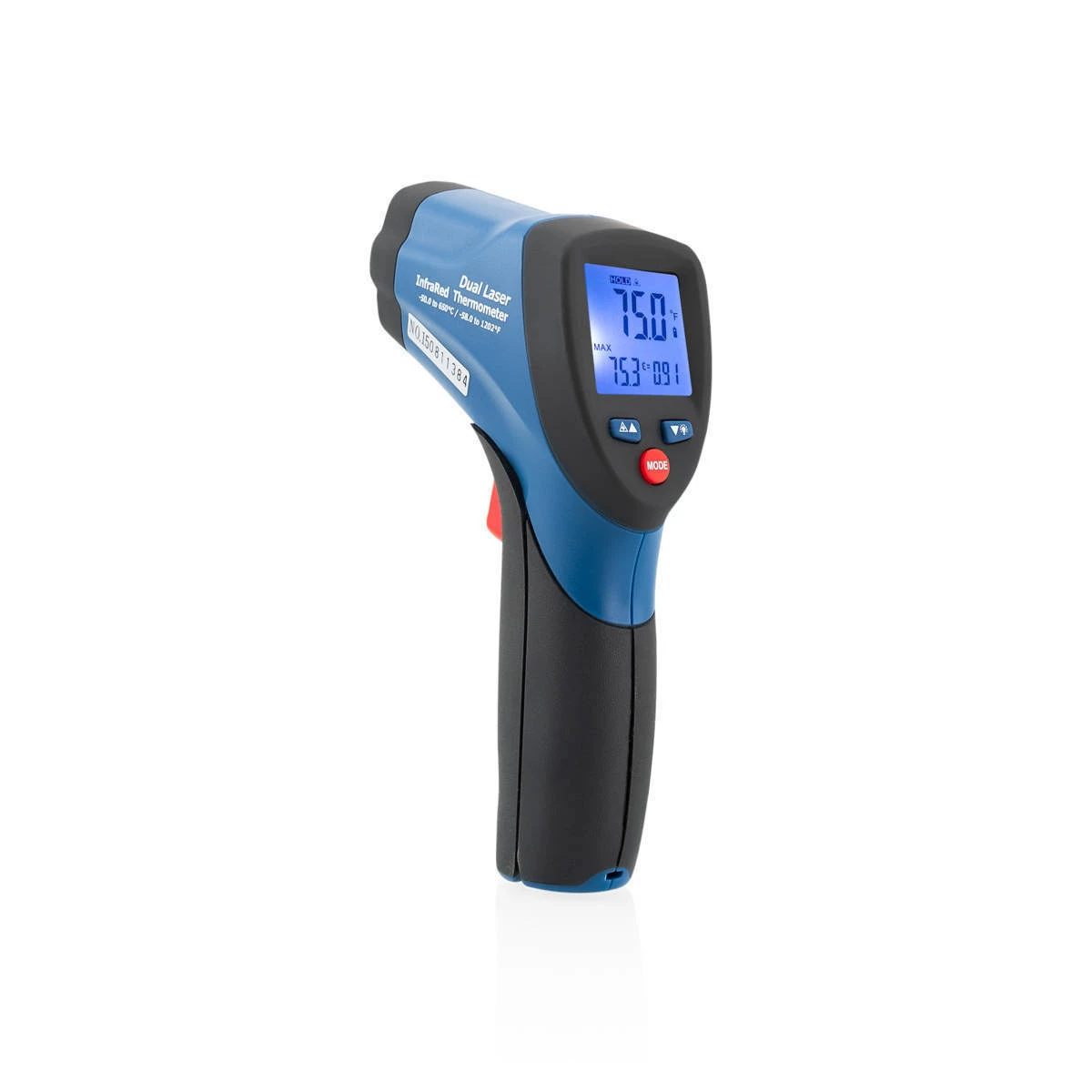
IR pyrometers and non-contact infrared thermometers for surface temperature measurement.
In depth
Thermal imaging cameras
→
Infrared thermal imaging cameras for electrical and building inspection, predictive maintenance and thermal diagnostics.
In depth
Temperature data loggers
→
Stand-alone temperature recorders for transport, warehousing, HVAC, pharmaceutical and food applications.
→
Heat-resistant thermal data loggers for the thermal profile of paint, powder coating and curing ovens.
In depth
Food and HACCP thermometers
→
Penetration and infrared thermometers for temperature control in kitchens, catering and food production.
The information on this page is provided for information purposes. Although it has been compiled with the greatest care, it may contain transcription errors or typos: for precise, up-to-date information please contact RODER SRL directly.
Contacts & Information
Contact for general information : info@roder.it
Machine Vision Division of RODER : www.visiotronix.com
RODER Instruments Division : www.innovacheck.com
More about RODER : about us
The information contained in this website is provided for information purposes only. Although it has been prepared with the greatest care, it does not constitute a contractual offer or a binding commitment to supply. It may contain transcription, translation or typographical errors. For precise and up-to-date information, please contact our company directly.
Note: Some images on this website have been intentionally generated using artificial intelligence (AI). This is because, for many applications and projects, photographs of the actual installation or system cannot be disclosed owing to confidentiality agreements, contractual clauses and non-disclosure agreements (NDAs).
You must be logged in to post a comment.