





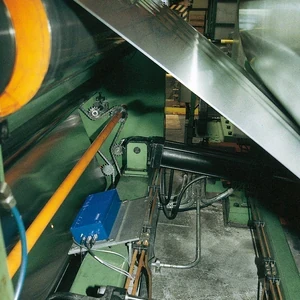
On hot strips and plates, non-contact measurement of speed and length remains accurate even on red-hot materials, where scale, high temperatures and high speeds make contact systems unsuitable.
- Non-contact measurement: even on red-hot materials
- High temperature: no contact with scale
- High speed: up to 50 m/s
- High accuracy: uncertainty down to 0.025 %
- No wear: no measuring wheel
- Cut-to-length: accurate and repeatable length
- Simple integration: encoder outputs and fieldbus
Measuring the speed and length of hot strips is among the most demanding tasks in the steel industry: high temperatures, scale and high line speeds make contact systems unsuitable. ASTech optical velocimeters measure without contact even on red-hot materials, maintaining accuracy and repeatability.
This page is part of the Steel and metals section and explains how to measure reliably on hot strips and plates, for example in rolling mills and continuous casting lines.

Would you like help choosing the right product ?
Why hot measurement is critical
On hot products the surface is red-hot, irregular and covered with scale; in addition, the material can oscillate vertically (flutter) and travel at very high speeds. In these conditions measuring wheels wear quickly, slip and introduce errors. However, speed and length control must remain accurate, because it determines elongation, synchronisation between the stands and the quality of the downstream cut. As a result, a stable and robust non-contact measurement becomes indispensable.
The VLM500 measures up to 50 m/s with an uncertainty of less than 0.025 % and, thanks to the automatic adjustment of exposure and brightness, also handles the red-hot and variable surfaces of hot products.
Protection and cooling for high temperature
To work in front of a red-hot strip, the instrument is housed in a protective housing with water or air cooling and pressurisation: in this way the optical window stays clean and the sensor temperature is kept under control. For example, a protective nozzle and an air flow keep the optics free from scale and fumes. In addition, the available working distances (up to 330 mm with the VLM500E version) make it possible to keep the instrument at a safe distance from radiant heat.
Advantages on hot strips
- Non-contact measurement on red-hot materials
- Speed up to 50 m/s and uncertainty < 0.025 %
- Cooling and pressurisation housings for high temperature
- Tolerance to strip flutter thanks to the wide working range
- No wear: high availability in continuous operation
Elongation control and synchronisation
In rolling mills, measuring the speed of the product at several points makes it possible to calculate elongation and to adjust the ratios between the stands, avoiding tension or looping. Likewise, knowing the actual speed of the strip makes it possible to synchronise the downstream drives, such as shears and coilers. For this reason optical measurement is not only used to count metres, but contributes to the overall stability of the rolling process.
The length measurement, obtained by integration, then feeds the cut-to-length and piece sizing functions described on the Cutting and Slitting page.
Recommended products

VLM500 optical speed meters
Speeds up to 50 m/s, uncertainty < 0.025 %, CCD spatial filter.

VLM60 optical encoder
A replacement for measuring wheels, measuring down to 0 m/s.

Cutting and slitting
Cut-to-length and slitting with high accuracy.
Where it is installed in rolling mills
The measurement on hot products can be located at different points of the rolling mill. Upstream, immediately after the first stands, it provides the entry speed needed to calculate elongation. Between the intermediate stands it makes it possible to balance tensions, avoiding looping or tearing of the material. Downstream, before the shears and coilers, it guarantees the correct length for cutting and coiling. In each position, the working distance and the protective housing are chosen according to the temperature and the space available.
Since hot products emit strong thermal radiation, it is good practice to keep the instrument at an adequate distance and to shield it with a cooled protective nozzle. In this way the optical quality of the measurement is preserved even close to material at very high temperature.
Stability of the measurement over time
One of the main advantages in this type of application is long-term stability. Measuring wheels, in contact with hot and abrasive products, deteriorate within a few weeks and require continuous recalibration. The optical velocimeter, having no contacting parts, instead keeps its accuracy constant for years. As a result, the number of line stoppages for maintenance and recalibration is drastically reduced, with a direct impact on plant productivity.
In addition, the repeatability of the measurement facilitates automation: the process parameters can be based on a stable signal, without having to compensate for drift due to wear. This makes the solution particularly suitable for plants that operate continuously over several shifts, where reliability is an essential requirement.
Integration with the automation system
The speed and length signal is made available through incremental encoder outputs, an analogue current output and the main industrial fieldbuses. As a result, integration with the line PLC and with supervision systems is simple and standardised. RODER technical support assists the customer in defining the configuration, choosing the protective housing and commissioning on site.
Application examples in the hot sector
The most frequent applications include measuring the strip speed at the exit of the roughing mill, checking the length before the flying shear and synchronising the hot coilers. In all these cases the optical velocimeter provides a stable speed reference independent of contact, on which the automation system builds its own control. In addition, on hot long products such as wire rod and bars, the measurement enables cut-to-length without the wear typical of wheels exposed to scale.
In short, the combination of non-contact measurement, cooling housings and a wide working range makes the VLM500 a reference instrument for the control of hot products, where reliability and continuity of operation are decisive for the productivity of the steelworks.
Frequently asked questions
Yes. The VLM500 optically measures speed and length even on red-hot strips and plates, thanks to the automatic exposure adjustment and the cooling housings.
The VLM500 offers an uncertainty of less than 0.025 % at the nominal distance, with speeds up to 50 m/s and high repeatability.
With protective housings equipped with water or air cooling and pressurisation, which keep the optical window clean and the sensor temperature stable.
The wide working range and the different nominal distances (up to 330 mm) tolerate the vertical oscillations of the strip, keeping the measurement accurate.
It makes it possible to calculate elongation, adjust the ratios between the stands and synchronise downstream drives such as shears and coilers.
Related products
The RODER instruments for this application. Go to the relevant catalogue pages for models, technical data and documentation.

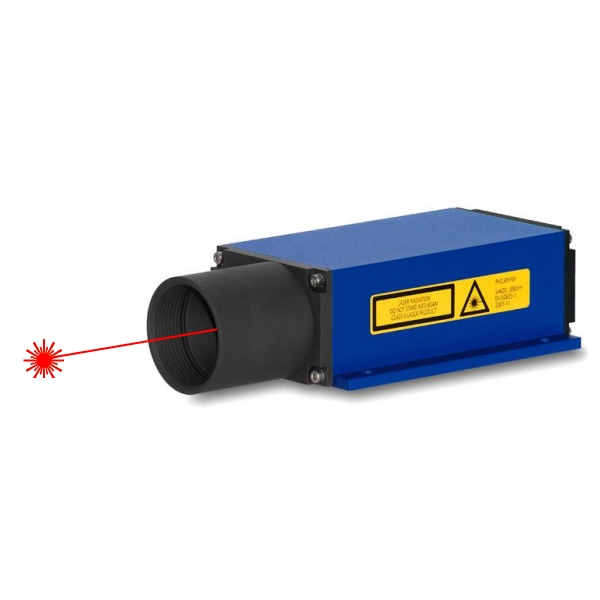
Industrial LASER distance sensors
LDM LASER distance sensors for non-contact distance, position and level measurement.
Contacts & Information
Contact for general information : info@roder.it
Machine Vision Division of RODER : www.rodervision.com
RODER Instruments Division : www.innovacheck.com
More about RODER : about us
The information contained in this website is provided for information purposes only. Although it has been prepared with the greatest care, it does not constitute a contractual offer or a binding commitment to supply. It may contain transcription, translation or typographical errors. For precise and up-to-date information, please contact our company directly.
Note: Some images on this website have been intentionally generated using artificial intelligence (AI). This is because, for many applications and projects, photographs of the actual installation or system cannot be disclosed owing to confidentiality agreements, contractual clauses and non-disclosure agreements (NDAs).
You must be logged in to post a comment.