
RODER VISION | LED ring lights
LED rings for machine vision systems

The Photolux ring illuminators light the object along the optical axis thanks to the central aperture for coaxial mounting of the camera, reducing shadows and reflections. They are built with a high-density ring LED array and incorporate constant-current drivers (MCCD, with RCCR© on the DC6) for stable emission, and HTTM© technology for thermal management. The range comprises the DC5 and DC6 series with high-intensity direct light — with selectable beam angle (DC5) and up to 12,000 cd and 10 sizes (DC6) — and the DC7 series with diffused light and PWM control. They are available in white, blue, red and infrared, are powered at 24 Vdc with an M8 connector and are ideal for inspection, robot guidance and component verification.
On this page
How to choose the LED ring light
The choice depends on the type of lighting and on the size of the object:
- Type of light: direct and intense (DC5, DC6) or diffused (DC7)
- Central aperture for coaxial mounting of the camera
- Beam angle: selectable on the DC5 (15/30/45/120°)
- Intensity and sizes: up to 12,000 cd and 10 sizes on the DC6
- Colours: white, blue, red and infrared depending on the model
Model comparison
| Feature | DC5 | DC6 | DC7 |
|---|---|---|---|
| Lighting | Direct, ring | Direct, ring | Diffused, ring |
| Central aperture | Yes | Yes | Optional |
| Angle | 15/30/45/120° | — | — |
| Colours | White, blue, red, IR | White, blue, red, IR | White, blue, red |
| Sizes | 300×300, 500×500 | 150×150 – 550×650 (10) | 300×300, 500×500 |
| Driver | MCCD | MCCD + RCCR© | MCCD |
| Supply / IP | 24 Vdc ±10% / IP40 | 24 Vdc ±5% / IP40 | 24 Vdc ±5% / IP40 |
The models

DC5 series
High-intensity direct-light ring with central aperture and selectable angle (15/30/45/120°), 3 colours, sizes 300×300 and 500×500 mm.
DC6 series
High-intensity ring (up to 12,000 cd) with central aperture, 4 colours, 10 sizes from 150×150 to 550×650 mm, MCCD+RCCR© driver.
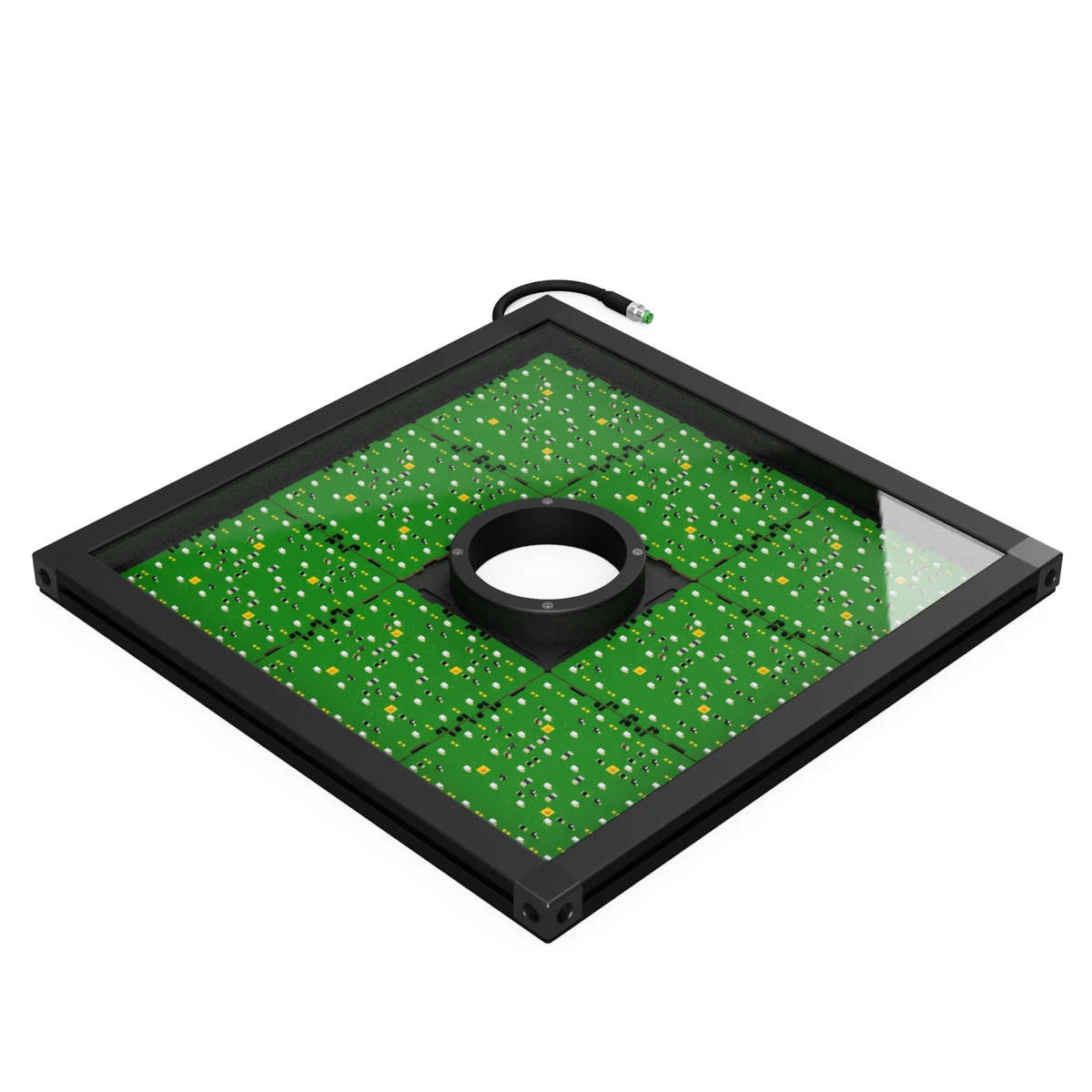
DC7 series
Diffused-light ring with optional central aperture and PWM control, 3 colours, sizes 300×300 and 500×500 mm.
Typical applications
LED illuminators for vision are used in numerous inspection, quality control and robot guidance applications. Some applications built and documented:
Special lighting for vision
Special lighting systems for in-line industrial vision: LED illuminators with direct, diffused, coaxial or backlight illumination to bring out the contrast and detail of the objects to be inspected.

Visual inspection of miniaturised components
The visual inspection of miniaturised components with machine vision systems calls for dedicated, uniform LED illuminators: the right light brings out defects and detail with accuracy and repeatability.

Vision systems for quality control
Machine vision systems for in-line quality control combine cameras and dedicated LED illuminators to obtain sharp, repeatable images for the automatic detection of defects.
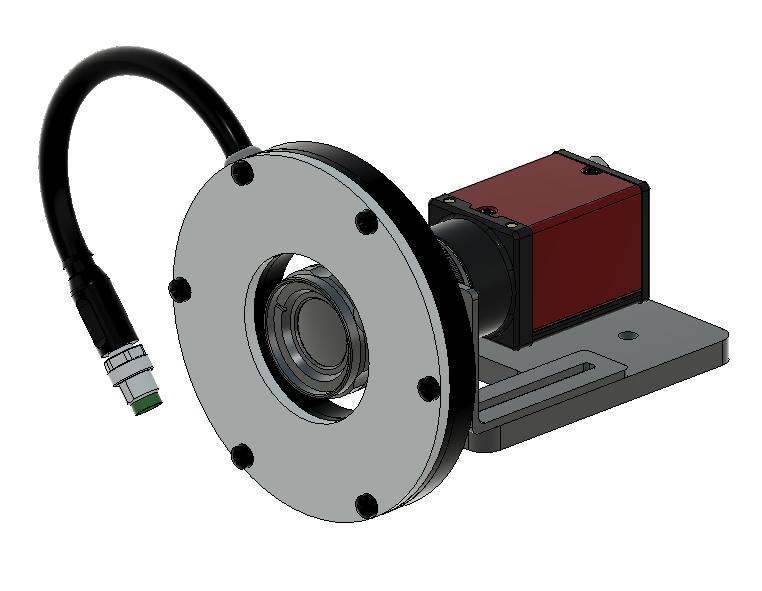
LED ring illuminators for coaxial lighting
Ring illuminators with a central aperture allow the camera to be mounted along the optical axis, giving axial lighting that reduces shadows and reflections. The DC5 and DC6 series offer high-intensity direct light, while the DC7 series provides a softer, diffused light.
See the DC5, DC6 and DC7 datasheets for beam angles, sizes, colours and part numbers.
Contacts & Information
Contact for general information : info@roder.it
Machine Vision Division of RODER : www.rodervision.com
RODER Instruments Division : www.innovacheck.com
More about RODER : about us
The information contained in this website is provided for information purposes only. Although it has been prepared with the greatest care, it does not constitute a contractual offer or a binding commitment to supply. It may contain transcription, translation or typographical errors. For precise and up-to-date information, please contact our company directly.
Note: Some images on this website have been intentionally generated using artificial intelligence (AI). This is because, for many applications and projects, photographs of the actual installation or system cannot be disclosed owing to confidentiality agreements, contractual clauses and non-disclosure agreements (NDAs).