






Non-contact optical velocimeter and encoder for continuous measurement of speed and length on moving strips, sheets, tubes, wires and profiles.
- Non-contact optical principle with spatial filter and CCD sensor
- Speed up to 50 m/s (up to 3000 m/min in the extended range)
- Measurement uncertainty < 0.025 % at the nominal distance
- Slip-free measurement, with no wear and no maintenance
- White-light LED illumination, with no harmful LASER light
- Working distances 185 / 240 / 330 mm depending on the version
- Multiple industrial interfaces and pulse encoder output

Would you like help choosing the right product ?
Why choose the VLM500
- Non-contact and slip-free measurement: the spatial filter optical principle eliminates the errors typical of measuring wheels, eliminating mechanical wear and maintenance.
- High accuracy: measurement uncertainty < 0.025 % at the nominal distance, < 0.05 % in the working range and < 0.2 % in the extended working range; reproducibility < 0.025 %.
- Almost independent of the material: measures on almost all surfaces (metal, paper, textiles, plastic, ceramics, wood, rubber) thanks to the automatic adjustment of exposure time and brightness.
- Robust and compact construction: IP 65 housing, insensitive to contamination, for safe and space-saving installations in industrial environments.
- Flexible integration: available with various industrial interfaces (RS232, RS422/485, USB, Profibus DP, Profinet IO, EtherNet/IP), pulse encoder output and analogue output.
- Long-term reliability: expected life > 15 years, 60-month warranty, Made in Germany.
The VLM500 is a non-contact optical velocimeter and encoder for continuous measurement of the speed and length of moving objects. It works according to the spatial filter principle: the surface of the material is illuminated by an integrated white-light LED and the reflected light, modulated by the granular structure of the surface, is detected by a CCD sensor. The resulting frequency is proportional to the speed of the object; the length is obtained by integration over time.
Since the measurement is made without contact and without slippage, the VLM500 eliminates the wear and errors typical of measuring wheels. The rapid automatic adjustment of exposure time and brightness makes it possible to measure on almost all surfaces, making the instrument suitable for many industrial sectors: metal, paper, wood, ceramics, textiles, plastic and rubber.
The compactness and robustness of the housing (IP 65) allow safe and space-saving installations. Depending on requirements, the VLM500 can be equipped with various industrial interfaces, pulse outputs and an analogue output, for integration into the automation systems of winders, cutting lines, coating and inspection lines, paper machines and extruders.
Technical documentation
 | VLM500 datasheet | Datasheet |
| VLM500 manual | Manual |
| VLM500 manual, DG special version | Manual |
Operating principle

The VLM500 is based on the spatial filter principle. The light from a white-light LED illuminates the surface of the moving object; the reflected light, modulated by the morphology (granularity) of the surface, is projected onto a CCD sensor that acts as a reference grating.
The movement of the material generates a signal whose frequency is proportional to the speed. The length is calculated by integrating the speed over time. Internal control loops automatically adjust exposure time and brightness, ensuring rapid adaptation to different surface conditions and a measurement that is practically independent of the material.
Available versions
The VLM500 is available in four versions that differ in working distance and measuring range, to suit different installation geometries and line speeds.
| Version | Nominal distance and working range | Measuring range | Measuring range (extended range) |
|---|---|---|---|
| VLM500A | 185 ± 15 mm | 0.6 … 2200 m/min | 1.2 … 3000 m/min |
| VLM500D | 240 ± 15 mm | 0.18 … 1200 m/min | 0.72 … 2400 m/min |
| VLM500L | 185 ± 10 mm | 0.12 … 250 m/min | 0.30 … 600 m/min |
| VLM500E | 330 ± 30 mm | 0.60 … 2000 m/min | 1.00 … 2700 m/min |

The VLM502 version with compact head is also available, designed for installations with limited space, while keeping the same optical measuring principle as the VLM500 series.
Technical specifications
| Measuring principle | Non-contact optical, spatial filter with CCD sensor |
| Maximum speed | up to 50 m/s |
| Measurement uncertainty | < 0.025 % at the nominal distance; < 0.05 % in the working range; < 0.2 % in the extended range |
| Reproducibility | < 0.025 % |
| Update time | > 0.2 ms, with additional moving average 1 … 32 times |
| Length measuring range | internal up to 2,000,000 km |
| Lighting | White-light LED (no LASER light) |
| Power supply | 24 VDC, max 25 W |
| Operating temperature | 0 °C … 50 °C |
| Degree of protection | IP 65 |
| Weight and dimensions | approx. 3.6 kg; 260 × 160 × 90 mm (without connections) |
| Programming interfaces | USB, RS-232, RS-422/RS-485 (isolated) |
| Pulse output (encoder) | A/B, 2 phases 90°, resolution 8 ns, 0.2 Hz … 25 kHz |
| Analogue output | current, adjustable 0 … 20 mA, 0 … 24 mA, 4 … 20 mA |
| Fieldbus | Profibus DP, Profinet IO, EtherNet/IP, Telnet/UDP via Ethernet |
| EMC compliance | EN 61326-1 (group 1, class A) |
| Expected life / warranty | > 15 years / 60 months — Made in Germany |
Applications
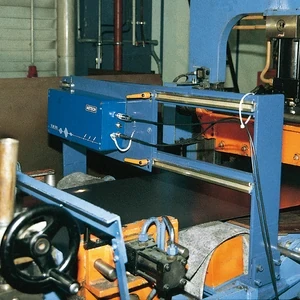
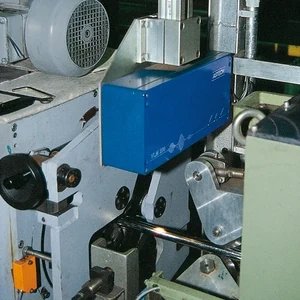
- Length and speed measurement on winders, cutting (slitting) lines, coating and inspection lines
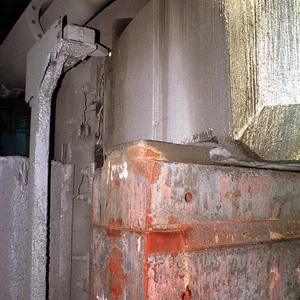
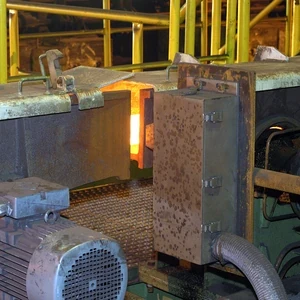
- Steel and metallurgical industry: strips, sheets, wire rod, bars, tubes and drawn products, even when red-hot
- Paper industry: speed measurement on stock, wire and sheet in paper machines
- Extrusion: speed control and cut-to-length on extruded materials
- Quality control and inspection: cutting, positioning, adjustment and dimensional verification of profiles, strips, sheets, cables and ropes
Accessories
The VLM500 series can be completed with accessories for mounting, alignment, display and protection in harsh environments.

MPL1 mounting plate
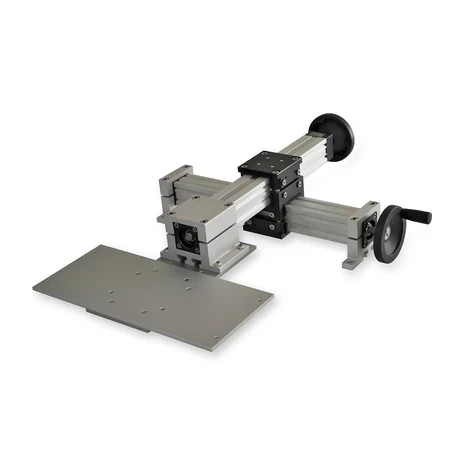
Alignment unit
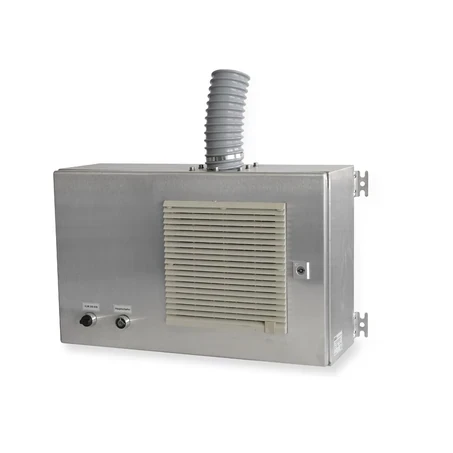
AC5 cooling/pressurisation
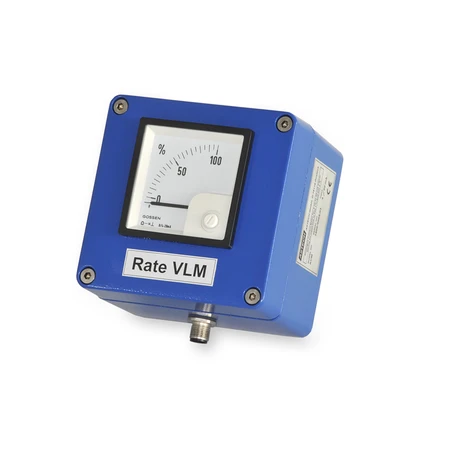
External display
Frequently asked questions
The VLM500 uses the spatial filter optical principle: a white-light LED illuminates the surface and a CCD sensor detects the reflected light modulated by the granularity of the material. The frequency of the signal is proportional to the speed and the length is obtained by integration, with no contact or slippage.
The measurement uncertainty is less than 0.025 % at the nominal working distance, less than 0.05 % in the working range and less than 0.2 % in the extended working range. Reproducibility is less than 0.025 %.
Thanks to the automatic adjustment of exposure and brightness, the VLM500 measures on almost all surfaces and materials: metal, paper, textiles, plastic, ceramics, wood and rubber.
The VLM500 can be configured with USB, RS-232 and RS-422/485 interfaces, Profibus DP, Profinet IO and EtherNet/IP fieldbuses, as well as an A/B pulse encoder output and an analogue current output (0…20 mA, 4…20 mA).
The versions VLM500A, VLM500D, VLM500L and VLM500E are available, which differ in working distance (from 185 to 330 mm) and measuring range (from 0.12 up to 3000 m/min in the extended range). The compact version VLM502 is also available.
Contacts & Information
Contact for general information : info@roder.it
Machine Vision Division of RODER : www.rodervision.com
RODER Instruments Division : www.innovacheck.com
More about RODER : about us
The information contained in this website is provided for information purposes only. Although it has been prepared with the greatest care, it does not constitute a contractual offer or a binding commitment to supply. It may contain transcription, translation or typographical errors. For precise and up-to-date information, please contact our company directly.
Note: Some images on this website have been intentionally generated using artificial intelligence (AI). This is because, for many applications and projects, photographs of the actual installation or system cannot be disclosed owing to confidentiality agreements, contractual clauses and non-disclosure agreements (NDAs).
You must be logged in to post a comment.