





Stroboscopes are optical instruments that generate high-frequency flashes of light in order to “freeze” rotating and periodic motion visually, allowing visual inspection, quality control and operational analysis of rotating machinery and moving parts. They are used in the textile industry (rotary printing, weaving, knitting), in industrial printing (offset and flexo presses), in the inspection of rotors, fans and gears, in engine R&D, in vibration analysis and in fluid dynamics studies. Being able to observe an object in rapid rotation clearly, without interrupting the process, is a valuable diagnostic tool.

Would you like help choosing the right product ?
Operating principle
The principle is based on the stroboscopic effect: if a rotating object is illuminated with flashes of light synchronised exactly to the frequency of rotation, at every flash the observer’s eye perceives the object in the same position, giving the illusion that it is stationary. By varying the flash frequency slightly, a slow-motion effect is obtained: the object appears to rotate slowly in one direction or the other. When the instrument is adjusted for apparent standstill, the flash frequency corresponds to the frequency of rotation (in revolutions per second), easily converted into RPM by multiplying by 60.
Technology types
The main types are: xenon-lamp stroboscopes (with a high-intensity flash lamp, a long industrial history, excellent brightness but limited lamp life — typically 100-300 million flashes); LED stroboscopes (of the new generation, with an array of high-efficiency, long-life LEDs, up to 100,000 hours of operation; lighter, more robust and with lower energy consumption). The flash frequency typically covers 30-12,000 flashes/min (corresponding to 0.5-200 Hz), which is sufficient for the most common industrial applications. For special applications at very high speeds there are specialised models reaching 50,000 FPM.
Industrial applications
The main applications are in: rotary printing (checking correct print position, identifying graphic defects with the machine running); the textile industry (checking weaving on looms, inspecting Jacquard loom movements, controlling circular knitting machines); maintenance of fans, rotors and shafts (checking for anomalies, imbalance and cracks in a rotor while running); analysis of mechanical components in periodic motion (bearings, gears, pulleys); R&D studies of engines, cutters and actuators; inspection of vibration in mechanical components while running.
Advanced functions
Modern stroboscopes integrate: an external trigger for synchronization with an encoder or rotation sensor (in order to fix the observation at a specific angular position); fine adjustment of the frequency for the slow-motion effect; phase setting (to position the flash at a desired angle relative to the external reference); adjustable flash intensity (dimmable LEDs); adjustable flash duration (to “freeze” very rapid movements more effectively); a DMX mode for integration into professional lighting systems. Wireless interfaces (Bluetooth) allow remote control, which is useful for difficult applications.
Safety
The use of stroboscopes in industry calls for safety precautions: flash frequencies from 5 to 30 Hz can induce photosensitive epileptic seizures in predisposed individuals; ranges above 70 Hz are generally safe, but prolonged exposure can cause visual fatigue and headaches. Industrial devices carry warnings and are fitted with interlocks where required. Use in a production environment requires training of personnel on the risks and on correct operation.
Selection criteria
Selecting a stroboscope takes into account: the maximum frequency required (it must exceed the maximum speed of the machine to be analysed); the luminous intensity needed (according to the size of the object and the distance); the technology (LED preferable for life and portability, xenon for intensity over long distances); the presence of an external trigger for phase analysis applications; portability (compact battery models for intensive field use); and robustness (IP protection rating).
Related products
The RODER instruments for this application. Go to the relevant catalogue pages for models, technical data and documentation.

In depth: optical stroboscopy ↑ up
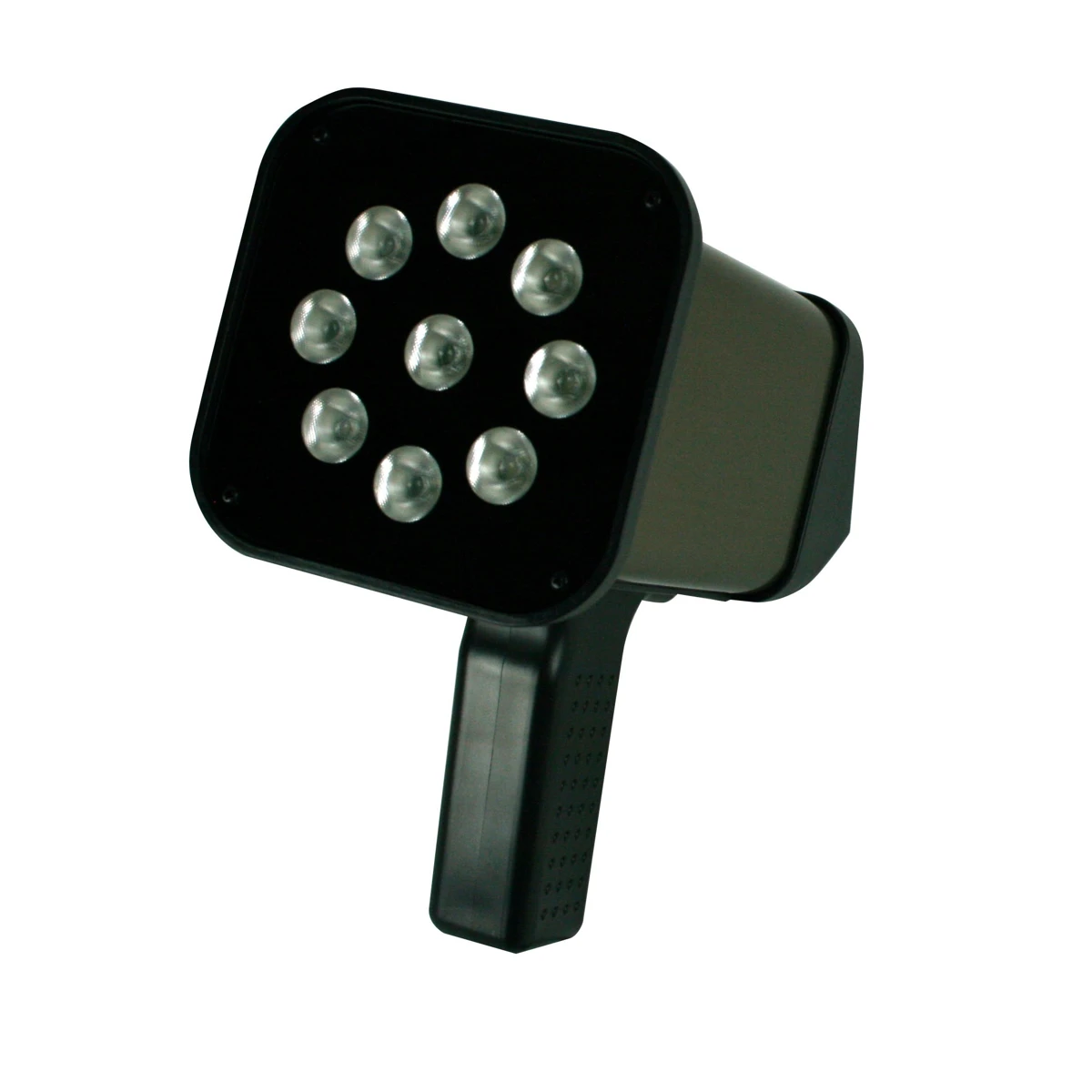
Optical stroboscopy is a non-contact measurement and inspection technique: by illuminating a moving object with flashes of light at an adjustable frequency, it is made to appear stationary or slowed down, so that its rotational speed can be measured and its details inspected.
- Stroboscopic effect: a moving object that appears stationary
- Non-contact RPM measurement: no wear or marks
- Adjustable frequency: FPM and Hz, wide range
- LED or xenon lamp: long life or intense flash
- Phase delay: analysis at any point of the cycle
- Flash duration: sharper images
- Synchronisation: external sensor input
Stroboscopy exploits persistence of vision: when a rotating or reciprocating part is illuminated by very short, repeated flashes of light, the eye perceives a sequence of “frozen” images. If the flash frequency coincides with the rotation frequency of the object (or with a submultiple of it), each flash illuminates the object in the same position every time and it appears stationary. By finely adjusting the frequency, the motion can be made to appear slowed down, forwards or backwards.
Because the measurement is purely optical and non-contact, it introduces no friction or wear, leaves no marks on the surface and does not require the machine to be stopped, making it ideal for process control and predictive maintenance. RODER offers the technology with the range of LED and xenon Shimpo stroboscopes.
What the stroboscopic effect is
The stroboscopic effect is based on the relationship between the flash frequency and the frequency of the motion. When the two frequencies are equal, the object is always illuminated at the same phase of its cycle and appears motionless. If the flash frequency is an exact multiple or submultiple of the rotation frequency, several equally spaced images or a single stationary image are seen. The frequency is expressed in flashes per minute (FPM) or in hertz (Hz); Shimpo stroboscopes cover very wide ranges, from 30–60 up to 120,000 FPM in the LED models.
How rotational speed (RPM) is measured
To measure the speed of a rotating part, the flash frequency is gradually increased until a single stationary image is obtained. It is important to check that you are not on a submultiple: at half the frequency, for example, the image may appear stationary depending on the symmetry of the object. Once the frequency corresponding to the first unambiguous stationary image has been found, the reading in FPM is equal to the speed in revolutions per minute. The ×2 / ÷2 functions and the +/− fine tuning of the Shimpo models speed up this search.
LED lamp and xenon lamp
The light source determines performance and field of use. LED technology (used by the ST-4000, ST-5000/ST-5100, DT-366, DT-326 and ST-320BL) offers a very long life with no bulb replacement and very wide frequency ranges (up to 120,000 FPM). The xenon lamp (models DT-735 and DT-311D) produces an extremely short (10–30 µs) and intense flash, very effective for detail, with a typical range of up to 12,000 FPM.
Phase delay and flash duration
Two advanced adjustments extend the analysis. The phase delay (in degrees, up to 0–359° on advanced models) makes it possible to “freeze” the object at any point of its cycle, in order to observe all its phases progressively. The adjustable flash duration reduces motion blur and produces sharper images for detailed inspection. With the external sensor input, the flash frequency can also be synchronised automatically with the speed of the process.
Applications of optical stroboscopy
- Predictive maintenance of motors, shafts, fans and impellers
- Inspection of moving gears, cams, belts and pulleys
- Quality control in printing, packaging and textiles
- Vibration analysis and balancing checks
- Non-contact RPM checks on production lines
For practical use in process control, see the in-depth article Monitoring RPM and rotational speed of machines.
RODER products for optical stroboscopy
RODER distributes the complete range of Shimpo stroboscopes, LED and xenon, portable battery-powered or mains-powered, with a UV light version for UV ink printing: ST-4000, ST-5000/ST-5100, DT-735, DT-311D, DT-366, DT-326 and ST-320BL.
Stroboscopy and vibration analysis
As well as measuring RPM, stroboscopy is an effective tool for vibration analysis. By adjusting the flash frequency close to the rotation frequency, components that vibrate or have play appear to move slowly, making visible resonances, loosening, misalignments and imbalances that are difficult to observe with the naked eye. This visual analysis, carried out while the machine is running, helps to diagnose the cause of abnormal noise and vibration and to verify the outcome of balancing or tightening work.
Safety and sectors of use
Shimpo stroboscopes use LED or xenon lamps, with no harmful laser light: this simplifies in-line use and reduces optical safety requirements. The technology is used across the printing, packaging, textile, automotive, cable, paper, steel, chemical and medical sectors, wherever it is necessary to check speed or inspect fast-moving parts without stopping production. The combination of measurement and inspection in a single portable instrument makes it a valuable aid for maintenance and quality control departments.
Frequently asked questions
What is optical stroboscopy?
It is a non-contact measurement and inspection technique that illuminates a moving object with flashes of light at an adjustable frequency: when the flash frequency coincides with that of the motion, the object appears stationary, allowing its rotational speed to be measured and its details to be inspected.
How is rotational speed measured with a stroboscope?
The flash frequency is adjusted until the rotating part appears as a single, unambiguous stationary image: the frequency in FPM is equal to the speed in revolutions per minute, checking that you are not on a submultiple.
Is an LED or a xenon stroboscope better?
LED models offer long life and very wide ranges (up to 120,000 FPM); xenon models produce a very short, intense flash (10–30 µs) ideal for detail, up to 12,000 FPM.
Does stroboscopy require laser light?
No: Shimpo stroboscopes use LED or xenon lamps, with no harmful laser light.
What is the phase delay for?
It makes it possible to “freeze” the object at any point of the cycle (0–359°) in order to analyse all the phases of the motion progressively.
Related products
The RODER instruments for this application. Go to the relevant catalogue pages for models, technical data and documentation.
Contacts & Information
Contact for general information : info@roder.it
Machine Vision Division of RODER : www.visiotronix.com
RODER Instruments Division : www.innovacheck.com
More about RODER : about us
The information contained in this website is provided for information purposes only. Although it has been prepared with the greatest care, it does not constitute a contractual offer or a binding commitment to supply. It may contain transcription, translation or typographical errors. For precise and up-to-date information, please contact our company directly.
Note: Some images on this website have been intentionally generated using artificial intelligence (AI). This is because, for many applications and projects, photographs of the actual installation or system cannot be disclosed owing to confidentiality agreements, contractual clauses and non-disclosure agreements (NDAs).
You must be logged in to post a comment.