





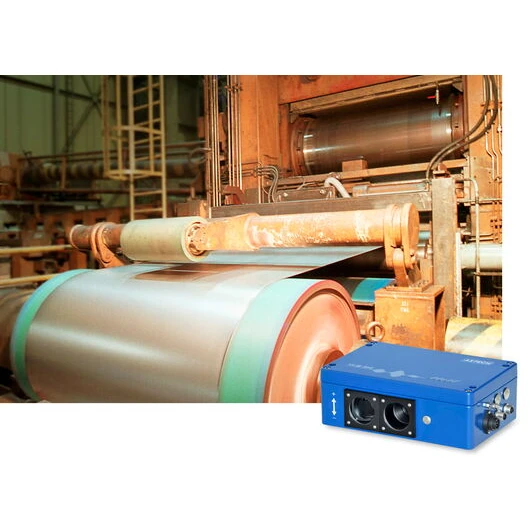
In converting and printing, non-contact measurement of speed and length governs cut-to-length, piece counting and roll length, with constant accuracy and repeatability.
- Non-contact measurement: no marks on the product
- Cut-to-length: accurate roll length
- Piece counting: reliable length and quantity
- Delicate materials: films, webs and reels
- No slippage: no measuring wheel
- Constant repeatability: stable over time
- Simple integration: encoder outputs and fieldbus
The speed and length measurement of products in converting and printing is the heart of process control: cut-to-length, piece counting and roll length all depend on it. ASTech optical velocimeters and encoders provide this measurement without contact, with accuracy and repeatability that remain constant over time.
This page belongs to the Paper, printing and converting section and describes how to accurately measure the length and speed of webs, films and reel products.

Would you like help choosing the right product ?
From speed to product length
The optical velocimeter measures the instantaneous speed of the material and, by integrating it over time, derives the length with high resolution. This data directly governs the cutting position and the piece count. Since the measurement is made without contact, there is no slippage: the length error is permanently reduced, to the benefit of product quality and material yield. As a result, scrap and disputes with customers decrease.
For fast lines the VLM500 is used (up to 50 m/s, uncertainty < 0.025 %); for the direct replacement of measuring wheels and for low speeds the VLM60 is ideal, accurate even at 0 m/s.
Piece counting and cut-to-length
In lines that produce bags, labels, sheets or cut lengths, piece counting and cutting length must be accurate and repeatable. An optical measurement with a fast update time makes it possible to trigger the cutter at the exact instant, keeping the length constant even when the line speed varies. For example, in label production, the accuracy of the length determines the correct die-cutting position.
Advantages for web products
- Accurate metre counting and length for rolls and products
- Accurate cut-to-length on bags, labels and sheets
- Non-contact measurement: no marks on the products
- Stable tolerance over time, without frequent recalibrations
- Integration with existing cutters, rewinders and counters
Registration and synchronisation
A stable speed measurement contributes to registration in printing presses and to the synchronisation of the units in converting lines. Keeping the ratios between the different stages constant reduces material waste and improves product quality. In addition, the availability of the data in real time facilitates automatic line adjustment, reducing manual intervention by the operator.
Since the signal is digital and drift-free, integration with supervision and labelling systems is simple and direct.
Reliability and return on investment
The absence of contacting parts eliminates the wear and periodic maintenance typical of measuring wheels. As a result, the line runs with greater continuity and the measurement maintains the same accuracy over time. Ultimately, especially in high-volume production, the return on investment is rapid: less scrap, fewer stoppages and more consistent product quality. RODER technical support assists the customer in choosing the model and during installation.
Recommended products

VLM500 optical speed meters
Speeds up to 50 m/s, uncertainty < 0.025 %, CCD spatial filter.

VLM60 optical encoder
A replacement for measuring wheels, measuring down to 0 m/s.

Optical encoder speed meters
Overview of the optical speed meter and encoder family.
Use cases in converting and printing
Speed and length measurement of products is used in many processes: rewinding with rolls cut to nominal length, production of bags and carrier bags to size, printing and die-cutting of labels, sheet cutting and lamination of laminates. In each case the same quantity, measured without contact, governs cutting and counting, ensuring the dimensional consistency of the finished product and the correct numbering of the pieces.
For example, in the production of self-adhesive labels, the accuracy of the length determines the die-cutting position and the number of labels per roll; an error of a few millimetres, repeated over thousands of pieces, results in scrap and disputes. Optical measurement eliminates this source of error at the root.
Length data and traceability
In addition to governing the cut, the length data feeds production documentation and traceability. Knowing exactly how many metres have been produced on each roll facilitates order management, automatic labelling and reporting to the customer. Since the signal is stable and drift-free, integration with management and MES systems is simple, with no need for the compensation for wear typical of contact measurements.
Managing format changes
Lines that produce bags, labels or sheets face frequent format changes. With a measuring wheel, each change may require checks and recalibrations; with optical measurement, on the other hand, switching from one format to another does not affect accuracy, because the measured quantity is the same regardless of the product. As a result, set-up times are reduced and the line quickly returns to full speed, an important advantage for small-batch production.
Accuracy and repeatability over time
The difference between a good and a bad length measurement is not seen on a single piece, but on the thousands of pieces in an order. A small systematic error, multiplied, becomes significant scrap. Optical measurement, free from slippage and wear, maintains a stable tolerance throughout production, without drift. For this reason it guarantees consistent quality even on long runs.
Data shared with several systems
The speed and length signal can be distributed simultaneously to several recipients: the cutter control, the line counter and the management system. Thanks to the encoder, analogue and fieldbus outputs, the same data feeds both the control functions and the production documentation, avoiding duplicated sensors and simplifying the line architecture.
Frequently asked questions
The optical velocimeter measures the instantaneous speed and integrates it over time to obtain the length, without contact and without slippage.
Yes. Accurate length measurement governs cut-to-length and die-cutting, keeping the size of the products constant.
No. Being non-contact, the measurement leaves no marks and does not deform films and delicate products.
The VLM500 for high speeds and maximum accuracy; the VLM60 to replace measuring wheels and to measure even at zero speed.
Yes. The incremental encoder output is compatible with counters, cutters and rewinders already installed.
Related products
The RODER instruments for this application. Go to the relevant catalogue pages for models, technical data and documentation.

Contacts & Information
Contact for general information : info@roder.it
Machine Vision Division of RODER : www.rodervision.com
RODER Instruments Division : www.innovacheck.com
More about RODER : about us
The information contained in this website is provided for information purposes only. Although it has been prepared with the greatest care, it does not constitute a contractual offer or a binding commitment to supply. It may contain transcription, translation or typographical errors. For precise and up-to-date information, please contact our company directly.
Note: Some images on this website have been intentionally generated using artificial intelligence (AI). This is because, for many applications and projects, photographs of the actual installation or system cannot be disclosed owing to confidentiality agreements, contractual clauses and non-disclosure agreements (NDAs).
You must be logged in to post a comment.