





Thickness measurement is an essential aspect in industry and in the metrology laboratory, above all in the production of continuous products. Measuring the thickness of a material correctly is fundamental to ensuring the compliance and the quality of the final product.
There are several thickness measurement techniques, including LASER thickness gauges, comparators, contact thickness gauges, fork thickness gauges and ultrasonic thickness gauges.
LASER thickness gauges are used to measure the thickness of easily deformable materials . Their precision is very high and they allow measurements to be taken without contact.
Comparators, on the other hand, are mechanical instruments used to compare the thickness of an object with a reference sample.
Contact thickness gauges are instruments that use a probe in direct contact with the surface to be measured. They are used in many sectors, such as metal production and the processing of wood, plastic and leather.
Fork thickness gauges are used to measure the thickness of thin materials, such as films, tapes or carpets.
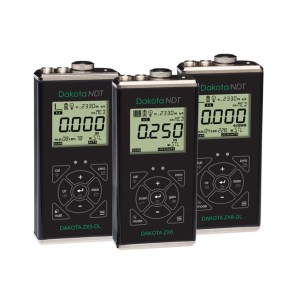
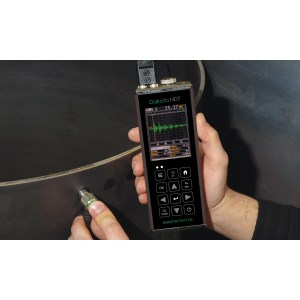
Ultrasonic thickness gauges use the ultrasonic echo to determine the thickness of a material. These instruments are particularly used in the shipbuilding and aeronautical industries to measure the thickness of metal components.
Product categories for thickness measurement




Would you like help choosing the right product ?
Some applications of thickness measurement products
Technical insight
Thickness measurement is a fundamental operation in industry and production. There are several techniques for measuring the thickness of an object, each with its own specific characteristics and advantages.
Thickness measurement with vernier calipers
Vernier calipers are one of the most common methods of measuring the thickness of an object. Thanks to their low cost and simplicity, they are used for a wide variety of applications in industry. There are various types of vernier caliper, each suited to specific measurement requirements.
Thickness measurement with industrial LASER distance sensors
LASER distance sensors are instruments that use a beam of light to measure the thickness of an object. These LASER instruments are often used in applications with large measuring ranges. Distance sensors employ high-precision lasers to determine the measuring point and are able to ensure high measuring accuracy. They can also be used at a distance or in the presence of environmental contaminants, since they require no direct contact with the object being measured.
Thickness measurement with contact micrometers
Contact micrometers are another method often employed to measure the thickness of an object. Thanks to their precision, contact micrometers are used in many industrial sectors and are available in many models. One drawback is that they can cause surface damage if used incorrectly, such as marks and scratches on the contact surface.
Thickness measurement with digital comparators
Digital comparators are high-precision instruments able to measure the thickness of small objects with a resolution of 0.0005 millimeters. These devices exploit the measuring principle of a high-precision linear transducer. Thanks to their precision and accuracy, digital comparators are often used in precision mechanics, automotive and aeronautical applications.
Thickness measurement with fork contact thickness gauges
Fork contact thickness gauges are instruments used to measure the thickness of flat objects, such as sheets or strips. These instruments are fitted with a fork connected to a spring, which presses against the object being measured. The results of this measurement are given by a graduated scale or a digital display. Thanks to their robustness and precision, fork contact thickness gauges are commonly used in industry and in material acceptance laboratories.
Thickness measurement with laser thickness gauges
Laser thickness gauges are instruments used to measure the thickness of materials through the use of laser light sources. These instruments offer high precision, allowing accurate measurement of thin and easily deformable materials. LASER thickness gauges are mainly used in production, where non-contact, high-speed measurement is required.
Thickness measurement with magnetic thickness gauges
Magnetic thickness gauges are a measuring technique widely used in the electroplating and painting industries. These instruments exploit magnetic fields and induced currents to detect variations in the magnetic field, in order to determine the thickness of materials. Magnetic thickness gauges allow the coating material to be measured without destroying the substrate.
Thickness measurement with ultrasonic thickness gauges
Ultrasonic thickness gauges are among the most widely used measuring instruments in shipbuilding, aircraft construction and the production of sheet metal parts. These instruments use ultrasound to measure the propagation speed of waves in a material. Based on the propagation speed of the waves, the thickness of the material can be determined. The great advantage of these instruments is that they can measure the thickness of a sheet working from one side of the material only.
Copyright by RODER SRL – Oglianico (TO) – Italy
Website: www.roder.it
Machine vision division: www.rodervision.com
Measuring instruments division: www.innovacheck.com
You must be logged in to post a comment.