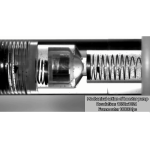




High-speed cameras combined with digital image correlation (DIC), or Digital Image Correlation, are a powerful technique for analysing the motion of objects and materials in a detailed and precise way. DIC is a non-invasive methodology for measuring deformations and displacements on solid surfaces, while high-speed cameras acquire images at extremely high frame rates, making visible movements and changes that occur in fractions of a second.
How the DIC technique works
The DIC technique is based on comparing sequences of high-speed images to determine the relative movements between points on the surface of an object. During the process, high-resolution images are taken of the surface under stress, such as deformation or vibration. Each image contains a series of unique patterns which, using DIC technology, are compared between successive frames to calculate displacements and deformations with extreme accuracy. This method is used in various fields, including mechanical engineering, the aerospace industry and materials research.
Applications in motion analysis
High-speed cameras are essential for capturing high-speed movements that would not be visible at traditional acquisition rates. The cameras record a large number of frames per second, creating smooth video sequences which, combined with DIC, allow detailed observation and analysis of dynamic deformations, vibrations or rapid movements of mechanical components, structures or materials. For example, in stress tests on metal or composite structures, these technologies make it possible to observe crack propagation or plastic deformation with unprecedented precision.
Stress and strain analysis
The combination of slow-motion footage and DIC is useful for analysing stresses in deformable structures under external loads. High-speed cameras capture even the smallest changes in position. DIC calculates deformations such as compression, torsion and bending in real time. This provides a complete map of three-dimensional movements during the test. This methodology improves understanding of the mechanical behaviour and strength limits of structures.
Advantages of the combined technology
The combined use of high-speed cameras and digital image correlation (DIC) offers numerous advantages:
- High precision: high-speed images provide extremely precise and detailed measurements of dynamic deformations.
- Real-time monitoring: DIC allows movements to be monitored in real time, increasing understanding of mechanical phenomena.
- Vibration analysis: high-speed cameras are crucial for analysing high-frequency vibrations that could not be detected with conventional methods.
- Non-invasiveness: as a completely non-invasive technique, DIC provides data without damaging the sample or object being tested.
Fields of application
This combined technology is used in many sectors, including:
- Materials research: to study the strength and behaviour of new materials under stress.
- Aerospace industry: to analyse the behaviour of aircraft components subject to high-speed vibrations.
- Civil engineering: to monitor the response of structures to dynamic stresses.
- Automotive industry: to test components subjected to stress during crash tests or endurance tests.
Conclusion
The combined use of high-speed cameras and digital image correlation (DIC) is a cutting-edge technology for advanced analysis of motion and deformation in various engineering fields. The ability to observe and precisely measure the behaviour of materials and structures under dynamic stress offers significant advantages in terms of safety, efficiency and technological innovation.
Video documentation
 Vuoi un aiuto nella scelta del prodotto ?
 Copyright by RODER SRL – Oglianico (TO) – Italy
Website: www.roder.it
Machine vision division: www.rodervision.com
Measuring instruments division: www.innovacheck.com