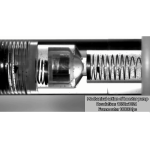




High-speed cameras are fundamental tools for analysing physical phenomena involving liquid materials, thanks to their ability to capture events that occur extremely quickly, often beyond the limits of human perception.
In particular, when combined with high-speed filming techniques, these cameras make it possible to observe and study complex dynamics concerning fluid behaviour, interaction with other materials and transitions from one physical state to another, such as cavitation, viscosity or evaporation.
The use of slow-motion footage provides a detailed and precise view of these phenomena, helping to understand mechanisms that are difficult to observe with traditional methods.
Applications in liquid materials
A classic example of the use of high-speed cameras in the field of fluids is the study of cavitation phenomena. Cavitation occurs when a liquid undergoes rapid pressure changes, forming vapour bubbles that implode and generate strong pressure waves. This phenomenon, which can damage equipment such as pumps and turbines, has been the subject of numerous studies using high-speed cameras. Slow-motion footage makes it possible to visualise the formation and implosion of bubbles, providing crucial information for designing more efficient and durable systems.
In the automotive industry, these cameras are used to analyse the behaviour of coolants inside engines. Observing flow dynamics in cooling systems at high operating speeds is essential to ensure that the liquid flows correctly, avoiding overheating or engine damage.
Studies of evaporation and foam formation
High-speed cameras are also used to study evaporation phenomena and the formation of foams in liquids. For example, in chemical and food industry applications, it is essential to understand how a liquid behaves when heated or mixed with air. Slow-motion footage can reveal the details of liquid evaporation, showing how vapour droplets form and detach. This type of analysis is crucial in sectors such as the food industry, where production processes need to be optimised, and in liquid treatment processes in the chemical industry.
Innovations in filming technologies
High-speed cameras use advanced sensors, such as CMOS or sCMOS, which capture very high-resolution images even in low-light conditions or during rapid phenomena.
The acquisition rates of these cameras can reach millions of frames per second, enabling detailed analysis of phenomena that occur in extremely short times. The images obtained are then played back in slow motion, allowing scientists and engineers to examine interactions between liquid particles, bubble formation and other behaviour that cannot be seen with low-speed cameras.
Conclusions
The use of high-speed cameras is fundamental for analysing the physical phenomena of liquid materials. These technologies provide a detailed understanding of rapid and complex events such as cavitation and evaporation. Advanced techniques make it possible to collect precise data. This data can improve products and industrial processes, optimising the design of systems with moving liquids. The technological development of cameras offers new research opportunities in various sectors.
Video documentation
 Vuoi un aiuto nella scelta del prodotto ?
 Copyright by RODER SRL – Oglianico (TO) – Italy
Website: www.roder.it
Machine vision division: www.rodervision.com
Measuring instruments division: www.innovacheck.com