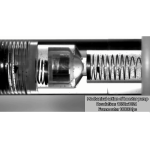




High-speed cameras are essential tools in the analysis of mechanical parts joined by spot welds, as they make it possible to observe and study the phenomena that occur during and after the welding process. These cameras can record millions of frames per second, capturing every detail of movements and deformations at high speed and making visible events that would normally escape the human eye. Slow-motion footage allows extremely precise analysis of the changes that occur during metal melting, hardening of the welded joint and post-weld deformation.
How high-speed cameras work
High-speed cameras capture images at such a rate that events can be slowed down and material behaviour observed at very high resolution. This is particularly useful for studying the welding process, which takes place in extremely short times, and for understanding how heat, pressure and forces affect the quality of the welded joint. Slow-motion footage can show crucial details such as weld pool formation, material movements during cooling and the propagation of any cracks or defects at the weld spot.
Applications in the analysis of welded parts
Welding is a complex operation that can significantly affect the quality and strength of mechanical components. High-speed cameras make it possible to examine various aspects of the welding process:
- Observation of melting: the cameras can record the metal melting phase, showing how the molten material spreads at the weld spot and bonds to the base part.
- Study of thermal deformation: during welding, heat can cause deformation of the parts. Slow-motion footage makes it possible to monitor how the material expands and contracts due to temperature variations.
- Solidification check: once the molten metal solidifies, joint quality depends on the cooling rate and the formation of the crystalline structure. High-speed cameras can show the solidification process in detail, identifying possible defects such as porosity or micro-cracking.
- Analysis of welding defects: the ability to observe details during cooling makes it possible to identify defects that may not be visible to the naked eye, such as micro-cracks or internal stresses.
Advantages of high-speed cameras
Using high-speed cameras for weld analysis offers numerous advantages:
- Greater precision: the cameras provide a detailed view of phenomena that occur in fractions of a second, improving understanding of welding processes.
- Early defect detection: thanks to slow-motion viewing, defects at the weld spot can be identified in real time, preventing failures or structural problems in mechanical parts.
- Welding process optimisation: real-time analysis allows engineers to optimise welding parameters such as temperature, cooling rate and pressure to improve the quality and strength of welded joints.
- Safety: detailed analysis of welding processes improves the safety of welded components, reducing the risk of structural failure or collapse.
Fields of application
The use of high-speed cameras in the analysis of welded parts is fundamental in several industrial sectors:
- Automotive industry: welds are widely used in the production of vehicle parts, and precise analysis is needed to ensure component safety and strength.
- Aerospace sector: welded joints must withstand extreme conditions. High-speed cameras make it possible to test and optimise processes to ensure maximum reliability.
- Civil and marine engineering: welding is crucial in the construction of structures and ships. High-speed cameras allow weld quality to be monitored precisely.
- Machinery manufacturing industry: welds are essential in the manufacture of industrial machinery and structural components. Analysing the quality of weld spots is fundamental to ensuring machine longevity and reliability.
Conclusion
High-speed cameras offer a unique opportunity in the analysis of welded mechanical parts, making it possible to monitor every stage of the welding process and identify defects or problems with great precision. Their application in critical sectors such as automotive, aerospace and civil engineering is fundamental to ensuring the quality, safety and reliability of welded components.
Video documentation
 Vuoi un aiuto nella scelta del prodotto ?
 Copyright by RODER SRL – Oglianico (TO) – Italy
Website: www.roder.it
Machine vision division: www.rodervision.com
Measuring instruments division: www.innovacheck.com