





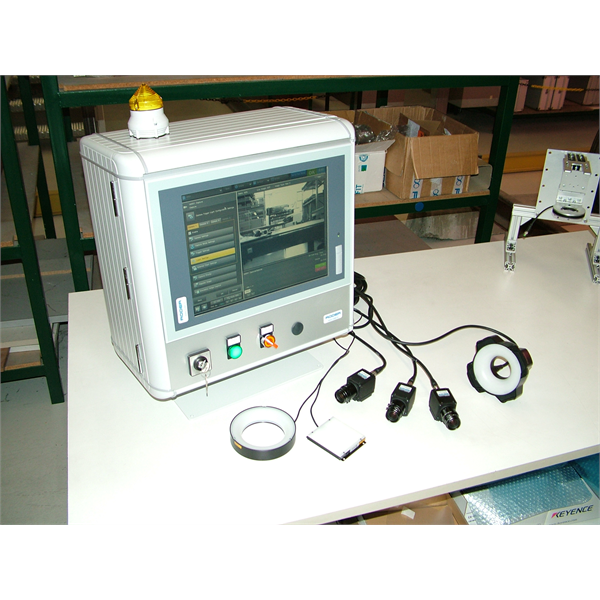
In modern production lines, machine vision systems are a fundamental technological pillar. These tools allow integrity inspection, OCR recognition and dimensional monitoring, guaranteeing quality and reliability at every stage of the production process.
The importance of in-line visual inspection
Automated visual inspection makes it possible to identify defects, read codes and verify product dimensions without slowing down production. This reduces the risk of errors, improves traceability and optimises operating efficiency.
How machine vision systems work
These systems use high-resolution cameras, specific lighting and advanced algorithms to capture, process and analyse images in real time. The information collected is then compared with the predefined parameters to detect any non-conformities.
Integrity inspection: what it is and why it is essential
Integrity inspection verifies that every product is free from aesthetic or functional defects. Thanks to machine vision, it is possible to identify anomalies such as scratches, deformations, missing components or damage during the production process.
Technologies used for integrity inspection
The most common technologies include:
- Multispectral cameras, to identify defects invisible to the human eye.
- LED lighting systems, to improve image quality.
- AI-based analysis software, to detect complex defects.
Applications of integrity inspection
These systems are used in sectors such as automotive, electronics, food and pharmaceuticals, where product quality is a fundamental requirement for guaranteeing user safety.
OCR recognition: optical character reading
OCR (Optical Character Recognition) makes it possible to read and decode alphanumeric codes, expiry dates, batch numbers and other information printed on products. It is an indispensable technology for traceability.
How in-line OCR recognition works
OCR systems acquire images of the products in motion and use advanced algorithms to identify the characters. Reading precision is optimised by means of calibrated lighting and contrast filters.
Advantages of OCR recognition
OCR recognition offers several advantages, including:
- Reduction of human error in reading codes.
- Greater speed than traditional methods.
- Integration with traceability and quality management systems.
Dimensional inspection: guaranteeing precision
Dimensional inspection ensures that every product respects the required technical specifications. Machine vision makes it possible to measure lengths, heights, diameters and other dimensions with extreme precision.
Non-contact measurement techniques
Machine vision systems use non-contact technologies such as:
- LASER triangulation, for three-dimensional measurements.
- Stereo vision, for shape and volume analysis.
- Photogrammetry techniques, for measurements on complex surfaces.
Integration with production lines
Machine vision systems are designed to integrate perfectly with existing production lines, guaranteeing continuous inspection without slowdowns. This characteristic makes them ideal for high-speed processes.
Automation and cost reduction
Automating visual inspection reduces operating costs by eliminating the need for manual inspections. It also improves productivity and makes it possible to allocate human resources to activities with greater added value.
Real-time data analysis
Thanks to real-time processing, machine vision systems report any non-conformities immediately, allowing rapid intervention and minimising scrap.
Artificial intelligence for advanced inspection
Modern vision systems integrate artificial intelligence and machine learning algorithms to improve detection capability and adapt to variable production conditions.
Compliance with quality standards
These systems help companies to comply with international quality standards, guaranteeing regulatory compliance and improving customer confidence in the products offered.
Machine vision systems for integrity inspection
Vision systems are used in numerous sectors, including:
- Automotive, for the inspection of components and welds.
- Pharmaceutical, to verify the integrity of packaging.
- Food, to inspect labelling and product quality.
Sustainability and waste reduction
Adopting machine vision systems contributes to more sustainable production, reducing waste of materials and improving energy efficiency.
Technological challenges and solutions
The main challenges include adapting to products with irregular shapes and handling high-speed lines. Thanks to advanced sensors and smart software, these issues can be successfully overcome.
Conclusions
Machine vision systems for integrity inspection, OCR recognition and dimensional inspection are an essential technology for companies aiming to improve the quality, productivity and sustainability of their processes. Investing in these solutions means guaranteeing competitiveness and innovation in an increasingly demanding market.
 Vuoi un aiuto nella scelta del prodotto ?
 Copyright by RODER SRL – Oglianico (TO) – Italy
Website: www.roder.it
Machine vision division: www.rodervision.com
Measuring instruments division: www.innovacheck.com
Applicazioni correlate :
 Machine vision systems for defect inspection on continuous products on the production line
 Inspection of the integrity, shape and dimensions of caps on the production line
 3D CMM measuring systems for the automatic inspection of dimensional and geometric characteristics on the production line
 Systems for dimensional inspection of drawn, extruded or welded tubes directly on the production line
 Machine vision systems for quality control on the production line