





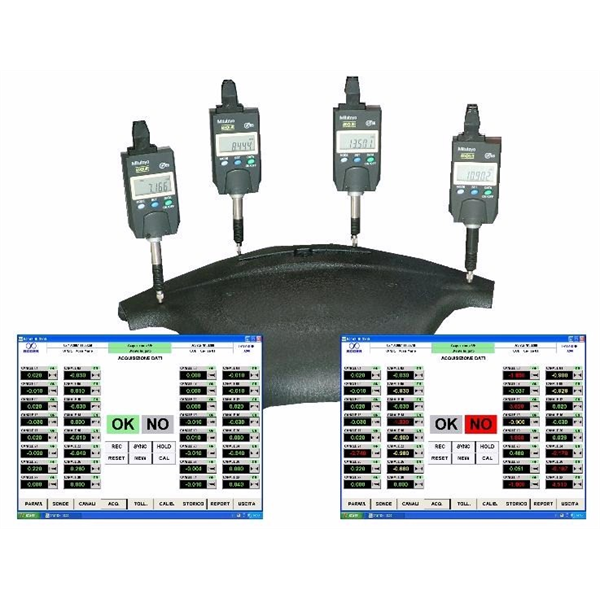
Laboratory systems and software for data acquisition from digital indicators, micrometers and callipers are essential to ensure precision and reliability in measurement. They simplify data management and support decision-making in industry and research.
The Importance of Digitising Measurements
Digitising the data acquired from measuring instruments improves efficiency, reduces human error and ensures complete traceability. This technological development is essential to meet modern quality standards.
Main Measuring Instruments Involved
The measuring instruments used in data acquisition systems include dial indicators, micrometers and digital callipers. Each plays a specific role, offering high precision for various applications.
Digital Indicators
Digital indicators are used to detect small dimensional variations with great precision. Their integration with software allows data to be collected continuously and accurately.
Digital Micrometers
Digital micrometers are ideal for precise measurement of thicknesses, diameters and lengths. Their connection to laboratory software ensures that every reading is recorded and can be analysed.
Digital Callipers
Digital callipers offer versatility and precision in linear measurement. Integrated with data acquisition systems, they ensure centralised, simplified information management.
How Data Acquisition Systems Work
Data acquisition systems receive signals from the measuring instruments, process them and convert them into a digital format that can be read by software. This process ensures speed and precision in data handling.
Advantages of Digital Connection
Digital connection eliminates the need for manual transcription, reducing errors and improving operational efficiency. It also makes it possible to manage large volumes of data in real time.
Data Acquisition Software
The software associated with these systems offers advanced tools for data collection, processing and analysis. It facilitates report generation and performance monitoring over time.
Advanced Software Features
Modern software includes features such as comparison with nominal values, graphical display of results and data export in standard formats for further processing.
Integration with Quality Control Systems
Integrating data acquisition systems with quality control processes makes it possible to automate checks and ensure compliance with product technical specifications.
Real-time monitoring
Thanks to real-time monitoring, operators can take immediate action in the event of deviations, reducing downtime and improving productivity.
System Customisation
Data acquisition systems can be customised to the specific needs of each laboratory, ensuring maximum flexibility and process optimisation.
Applications in industrial sectors
These systems are used in various sectors, such as automotive, aerospace, medical and manufacturing, where the precision and traceability of measurements are essential.
Compliance with international standards
Using data acquisition systems and software helps companies meet international quality standards such as ISO and ASME, improving their competitiveness on the market.
Reduced operating costs
Automating data acquisition processes reduces working times and minimises errors, contributing to a significant reduction in operating costs.
Staff Training
To make the most of the potential of these systems, it is essential to provide adequate staff training, ensuring effective use of the instruments and software.
Technological innovations
Recent innovations include integration with IoT systems and the use of artificial intelligence for predictive analysis and optimisation of measurement processes.
Implementation Challenges
Despite the many advantages, implementing these systems requires an initial investment and careful planning to ensure a smooth transition and a return on investment.
Conclusions
Laboratory systems and software for data acquisition from digital indicators, micrometers and callipers are an indispensable resource for companies focused on quality and innovation. Thanks to their precision, reliability and integration capabilities, they provide fundamental support for improving production processes and maintaining high standards of competitiveness.
 Vuoi un aiuto nella scelta del prodotto ?
 Copyright by RODER SRL – Oglianico (TO) – Italy
Website: www.roder.it
Machine vision division: www.rodervision.com
Measuring instruments division: www.innovacheck.com
Applicazioni correlate :
 LASER measuring instruments for laboratory testing with data acquisition software
 Data acquisition and statistical calculation systems for quality control
 How a digital arch gauge works
 Contact thickness gauges for the production line and the metrology laboratory
 Machine vision systems for quality control on the production line