






LVDT linear transducers allow precision measurements on mechanical parts or on any object that can be measured with a contact probe.
Combined with dedicated signal amplifiers, they allow the measurement of dimensional characteristics (thicknesses, widths, positions, heights, diameters, ovality) and geometric characteristics (flatness, parallelism, perpendicularity, runout, eccentricity and coaxiality) with micron-level accuracy, even on complex mechanical parts.
LVDT transducers can be supplied with a spring-actuated system (with fixed mechanical preload) or as pneumatically actuated LVDT linear transducers, which are particularly suitable for automatic measuring systems.
Some families of LVDT probes can be made with a vacuum-based displacement mechanism.
Transducers can be supplied with radial cable outlet, with axial cable outlet or with quick connection and disconnection systems.
RODER builds complete turnkey systems consisting of LVDT probes, amplifiers and electronic controllers, data acquisition systems, statistical control software and purpose-designed mechanics.
RODER measuring systems are used in many industrial sectors: precision mechanics, sheet metal working, plastic moulding, electromedical, metallurgy and steel.

Would you like help choosing the right product ?
Applications of LVDT transducers
Typical applications of measuring systems based on LVDT transducers concern the measurement of mechanical parts and plastic products, and applications in the glass sector and in the metal forming sector.
Dimensional and geometric measurements and checks on stamped and blanked parts

LVDT probes, combined with MODULCHECK systems manufactured by RODER, allow the flatness of stamped, blanked, rolled or die-cast parts to be measured quickly and directly on the production line. Flatness is measured with an array of sensors capable of detecting differences with respect to a certified calibration master. The result of the test is a map of the areas checked with the corresponding numerical value of the deviation from the ideal shape.
A highly intuitive graphical presentation makes it possible to determine the non-conforming areas quickly and reliably. All the data obtained can be used for statistical calculations (Sigma, Cp, Cpk, Cm, Cmk) or to produce control charts (XS, XR, process trend, population distribution).
Shape checks on large parts

LVDT linear transducers, combined with MODULCHECK systems manufactured by RODER, allow the shape inspection of objects of any size and material. Shape inspection is carried out by comparison with a reference master and all differences are highlighted quickly and intuitively. Out-of-tolerance or partial non-conformity signals can be generated for the product. The system can also be installed in robotic inspection areas and unattended automatic inspection benches. In this configuration, all verification operations can be controlled directly by a PLC or by an automatic production system.
Runout and eccentricity measurements on rotating parts

LVDT probes, combined with MODULCHECK systems manufactured by RODER, make it possible to determine the geometric characteristics of parts rotated between centres. It is thus possible to measure diameters, ovality and runout, as well as roundness, cylindricity and radial profile data of the object (important in applications such as camshaft measurement). The measurement can also be acquired from measuring machines specifically developed for this type of inspection in the metrology laboratory or on the production line (3D measuring machines, profilometers, optical machines).
Common features of the systems offered by RODER
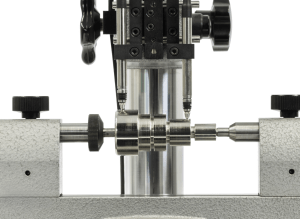
- Excellent repeatability, durability and service life.
- All RODER LVDT probes are mounted on ball bearings, with the exception of miniature axial probes.
- The ball guide is highly insensitive to radial forces exerted on the measuring rod. An anti-rotation device ensures perfect movement of the mechanical guide system.
- The guides of the axial probes are highly protected against the ingress of liquids (oil) or solids (dust) by protective bellows of elastomer quality.
- The inserts (measuring inserts) can be replaced. A wide choice of geometric shapes and sizes is available.
- The measuring force can be adjusted by changing the spring, depending on the probe model.
- Probe body diameter of 8 mm. It can be clamped along its entire length.
- IP65 degree of protection according to IEC 60529.
- Wide range of accessories, including measuring inserts, spring sets, etc.
- LVDT probes compatible with measuring equipment from other manufacturers available on request.
RODER offers a complete family of LVDT sensors (analogue electronic probes) and dedicated measuring instruments for the most demanding applications.
RODER standard LVDT probes
Standard probes, also known as half-bridge probes, work on the electrical principle of magnetic coupling. LVDT probes can be used in combination with measuring instruments from other manufacturers, to obtain a complete range of measurements and geometric surveys.
These probes are known as LVDT (Linear Variable Differential Transformer) probes. All RODER electronic probes can be used both with manual instruments, internal or external, and in combination with other typical measuring instruments and stands.
RODER can supply axial probes with linear displacement of the measuring stem, angular probes with tilting lever or parallel-guide probes, specifically designed for multi-gauging fixtures and any other equipment for in-process inspection, thus saving many assembly components, which, with very few exceptions, essentially perform comparative measurements.
Based on a main master, which may be a measurement standard, a setting ring or any other part accepted as such, various dimensions of the part under test are compared.
All measurements are made with high accuracy and repeatability and allow real-time product and process certification.
What is an LVDT linear transducer?
LVDT stands for Linear Variable Differential Transformer. It is a type of electromechanical transducer capable of converting the rectilinear motion of an object to which it is mechanically coupled into a corresponding electrical signal. LVDT linear position sensors can measure movements from a few millionths of a millimetre up to several millimetres.
The internal structure of the LVDT sensor consists of a primary winding centred between a pair of secondary windings, symmetrically spaced about the primary. The coils are wound on a single thermally stable former, encapsulated against moisture, wrapped in a high-permeability magnetic shield and then secured in a cylindrical stainless steel housing. This coil assembly is usually the stationary element of the position sensor.
The moving element of an LVDT is a separate tubular armature of magnetically permeable material. This is called the core, which is free to move axially within the hollow bore of the coil and is mechanically coupled to the object whose position is being measured. In operation, the LVDT’s primary winding is energised by an alternating current of appropriate amplitude and frequency, known as the primary excitation.
The LVDT’s electrical output signal is the differential AC voltage between the two secondary windings, which varies with the axial position of the core within the LVDT coil. This AC output voltage is usually converted by suitable electronic circuitry into a high-level DC voltage or current that is more convenient to use.
Why use an LVDT linear transducer?
Infinite resolution
Since an LVDT operates on electromagnetic coupling principles in a fully analogue system, it can measure infinitesimally small changes in core position. This infinite resolution capability is limited only by the noise in an LVDT signal conditioner and by the resolution of the output display. These same factors give an LVDT its outstanding repeatability.
Zero point repeatability
The position of an LVDT’s central null point is extremely stable and repeatable, even over its wide operating temperature range. This makes an LVDT perform well as a reference position sensor in closed-loop control systems and high-performance servo balance instruments.
Fast dynamic response
Its particular construction allows an LVDT to respond very quickly to changes in core position. The dynamic response of an LVDT sensor itself is limited only by the inertial effects of the core’s slight mass.
Absolute output
An LVDT is an absolute output device, as opposed to an incremental output device. This means that, in the event of a power failure, the position data sent by the LVDT will not be lost. When the measuring system is restarted, the LVDT’s output value will be the same as it was before the power failure.
Some examples of LVDT linear transducers

The inductive displacement transducer, also known as LVDT, is an electromagnetic device used to measure small displacements. The LVDT transducer offers high accuracy and repeatability even in harsh working conditions and in the presence of contaminants.
Position and displacement transducers are robust and reliable and ensure a long operating life. They offer measuring ranges between 0.2 and 10 mm. Economical, miniaturised, pressurised and spring-loaded versions are available, with or without built-in electronics.
LVDT sensors with larger measuring ranges, customised designs and wider temperature ranges can also be supplied.
Design notes on LVDT linear transducers
The transducer consists of a tube made up of three windings arranged with parallel axes and containing a movable cylindrical ferromagnetic core. The central winding is called the primary and the other two the secondaries: the primary is connected to an AC voltage generator, while the output voltage is measured across the secondaries.
When the core is in the centre, the voltage induced in the secondary windings, which are wound in opposite directions, is equal but opposite, so that the measured voltage signal is practically zero. As the core moves, however, the mutual inductances change and, depending on whether it moves to the left or to the right, the inductive coupling with the left or right secondary respectively becomes greater. As a result, the output signal varies in proportion to the displacement of the core.
Amplifiers for LVDT transducers
So-called phase-discriminating demodulators are used to convert the output signal of the LVDT. These are electronic devices that extract the RMS value of the voltage representing the displacement and determine on which side of zero the displacement occurs. The best known of all uses a double Graetz bridge that rectifies the alternating signal coming from the secondary windings and computes its algebraic sum. Depending on the sign of the sum, it is possible to tell on which side of zero the displacement has occurred.
The LVDT is a very sensitive transducer capable of measuring displacements in the order of fractions of a micrometre. Depending on the supply frequency of the primary and the mass of the core, cut-off frequencies of a few hundred hertz are obtained and therefore good dynamic responses to displacements that vary rapidly over time.
Related products
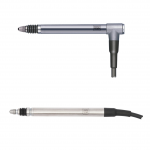
LVDT measuring probes
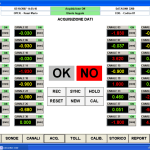
Software for measurement and control

DIGICHECK systems
Copyright by RODER SRL – Oglianico (TO) – Italy
Website: www.roder.it
Machine vision division: www.rodervision.com
Measuring instruments division: www.innovacheck.com
Applicazioni correlate :
 Digital linear transducers and LVDTs for dimensional and geometric inspection of mechanical parts
 Dimensional checks with multi-gauging units and LVDT linear transducers
 Flatness measurement with multi-gauging units and LVDT linear transducers
 Automatic fixtures for dimensional and geometric inspection with LVDT contact probes
 Manual fixtures for dimensional and geometric inspection with contact probes
You must be logged in to post a comment.