






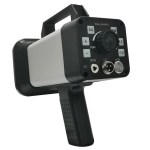
Xenon and LED portable stroboscopes are optical instruments that enable high-speed analysis of moving objects on production lines. By emitting very short flashes of light synchronised with the frequency of the motion, they make an object rotating or in a repetitive cycle appear “stationary”, allowing its details to be observed without stopping the machine. They are used for visual inspection, quality control, analysis of repetitive phenomena and preventive maintenance. As changeover times become ever shorter, these devices provide a detailed view of quality right after line start-up, helping to increase productivity and reduce scrap and costs.

Would you like help choosing the right product ?
Related products
Visit the RODER product catalogue to choose the stroboscope best suited to your application:

What is a stroboscope and how does it “freeze” motion
The stroboscope illuminates an object in constant motion with high-intensity flashes of light of very short duration. When the flash rate matches the frequency of the motion (rotary or oscillating), the eye perceives a perfectly still image of the object. Fine adjustment of the frequency produces a “slow-motion” effect, with an apparent slow movement that makes visible details otherwise impossible to see with the naked eye.
LED and Xenon stroboscopes compared
Xenon stroboscopes produce a very intense flash: the tube has a typical power of ≤ 45 W and a life in the order of 50 million flashes, with a flash duration of 10–30 µs that adapts automatically to the frequency. LED stroboscopes (for example with high-power CREE LEDs) offer a much longer service life, eliminate lamp replacement, are more energy-efficient and allow the pulse duration to be adjusted for sharper images. LED technology is also more versatile: it can be integrated into complex systems or used as a stand-alone unit.
Measurement parameters
- Typical flash range: 60–12,000 FPM (flashes per minute), switchable to Hz.
- Resolution: 0.1 FPM from 60 to 6,000, 1 FPM from 6,001 to 12,000.
- Flash duration: 10–30 µs (Xenon), adjustable on LED models for sharper images.
- Adjustments: frequency knob with ×2 and ÷2 functions, phase shift and synchronisation from an external sensor/controller.
High-speed optical analysis on the production line
On high-speed lines the stroboscope makes it possible to check process quality in real time, identifying assembly anomalies, repetitive defects and synchronisation problems without slowing down or stopping production. The information collected allows prompt intervention, increasing productivity and reducing scrap and downtime.
Typical applications
- Rotogravure and flexo printing, winders and unwinders
- Extrusion, blow moulding and moulding of plastics
- Gears, cams, belts and pulleys
- Fans, impellers and spindles
- Visual inspection and quality control of rotating parts
Frequently asked questions
Xenon produces a very intense flash with a tube of ≤ 45 W and a life of around 50 million flashes (duration 10–30 µs); LED has a much longer service life, requires no lamp replacement, is more efficient and allows the pulse duration to be adjusted.
By synchronising the flash rate with that of the motion, the moving object appears stationary: its details can thus be observed as if it were still.
Typically 60–12,000 FPM (flashes per minute), with resolution down to 0.1 FPM, switchable between FPM and Hz.
No: the analysis is carried out on the moving object, with no machine downtime or slowing of the process.
Contacts & Information
Contact for general information : info@roder.it
Machine Vision Division of RODER : www.visiotronix.com
RODER Instruments Division : www.innovacheck.com
More about RODER : about us
The information contained in this website is provided for information purposes only. Although it has been prepared with the greatest care, it does not constitute a contractual offer or a binding commitment to supply. It may contain transcription, translation or typographical errors. For precise and up-to-date information, please contact our company directly.
Note: Some images on this website have been intentionally generated using artificial intelligence (AI). This is because, for many applications and projects, photographs of the actual installation or system cannot be disclosed owing to confidentiality agreements, contractual clauses and non-disclosure agreements (NDAs).


You must be logged in to post a comment.