





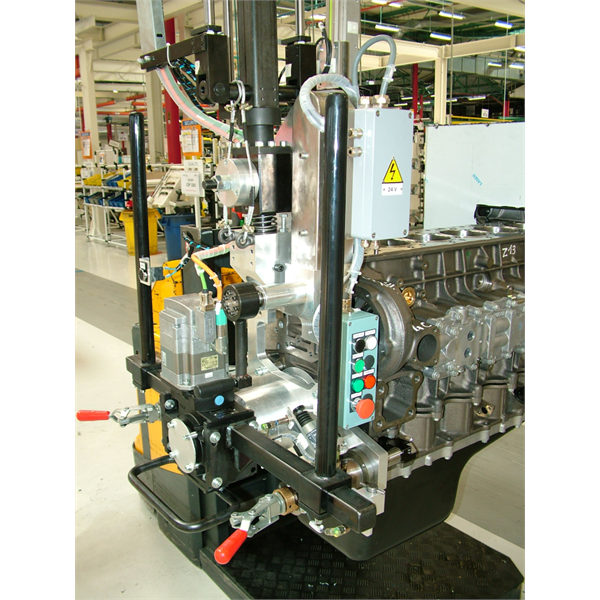
In modern production lines, efficiency and precision are key factors for operational success. Systems for checking timing and top dead centre (TDC) height are fundamental for ensuring that mechanical processes take place optimally. These systems are used in many sectors, including automotive, aerospace and manufacturing, where the quality and consistency of the final product are essential.
Function of the control systems
Timing control systems are designed to monitor and adjust the position of moving components inside machines and equipment. Timing is crucial for synchronising the movement of different parts so that they work in harmony. Top dead centre height, on the other hand, is the point at which a piston or another working element reaches its maximum height before reversing direction. Precise control of these parameters guarantees smooth production and reduces the risk of malfunctions.
Technologies used
Various technologies are used in timing and TDC control systems. Among these, optical sensors, rotary encoders and position-measuring devices are the most common. Optical sensors, for example, use light to detect the position of an object, while rotary encoders provide feedback on the angular position. These devices can be integrated into industrial automation systems to optimise operating performance.
Integration with automation systems
Integrating timing and TDC control systems with industrial automation systems is a key aspect for maximising efficiency. Through the use of advanced software and control algorithms, it is possible to monitor machine performance in real time and make dynamic adjustments. This approach makes it possible to reduce downtime and improve the overall productivity of the production line.
Importance of preventive maintenance
Preventive maintenance plays a crucial role in the functionality of timing and TDC control systems. A regular maintenance programme helps to identify potential problems before they turn into failures. This includes sensor calibration, cleaning of components and periodic performance checks. Investing in preventive maintenance not only extends the life of the systems, but also helps to guarantee the quality of the final product.
Challenges in industrial applications
Despite the numerous advantages, implementing timing and TDC control systems presents various challenges. Changing operating conditions, such as extreme temperatures and vibrations, can affect system performance. In addition, the complexity of modern production lines requires customised solutions and a thorough understanding of the interactions between the various components. Engineers must meet these challenges by designing robust and flexible systems.
Future developments and innovations
The field of timing and TDC control systems is constantly evolving, with continuous innovations aimed at improving reliability and efficiency. Emerging technologies, such as artificial intelligence and the Internet of Things (IoT), are transforming the way these systems are designed and managed. Real-time data analysis and failure prediction are just some of the applications that can further optimise production lines.
Economic considerations
From an economic point of view, implementing timing and TDC control systems can lead to significant long-term cost savings. By reducing production defects and improving efficiency, companies can achieve a favourable return on investment. It is essential, however, to weigh the initial cost against the long-term benefits, also taking into account the potential reductions in labour and material costs.
Conclusion and final thoughts
In conclusion, systems for checking timing and top dead centre height are essential for the efficient operation of modern production lines. Their implementation requires careful planning and in-depth knowledge of the production processes. With constant technological developments in the field, these systems will continue to play a fundamental role in optimising industrial performance. It is important to stay up to date with the latest innovations and adapt to changing production requirements to ensure the company’s success.
 Vuoi un aiuto nella scelta del prodotto ?
 Copyright by RODER SRL – Oglianico (TO) – Italy
Website: www.roder.it
Machine vision division: www.rodervision.com
Measuring instruments division: www.innovacheck.com
Applicazioni correlate :
 Machine vision systems for quality control on the production line
 Machine vision systems for defect inspection on continuous products on the production line
 3D CMM measuring systems for the automatic inspection of dimensional and geometric characteristics on the production line
 Machine vision systems for integrity inspection, OCR recognition and dimensional inspection on the production line
 Systems for timing inspection on camshafts