






Checking the tension actually applied to a bolt during tightening is one of the most delicate issues in mechanical assembly. The traditional method — torque control with a torque wrench — is subject to high intrinsic uncertainty, because the applied torque is converted into axial load only after overcoming thread and under-head friction, two quantities that are difficult to quantify and vary from bolt to bolt. The differential ultrasonic technique for measuring elastic elongation overcomes this limitation by directly measuring the effect of tightening on the bolt.

Would you like help choosing the right product ?
Related products

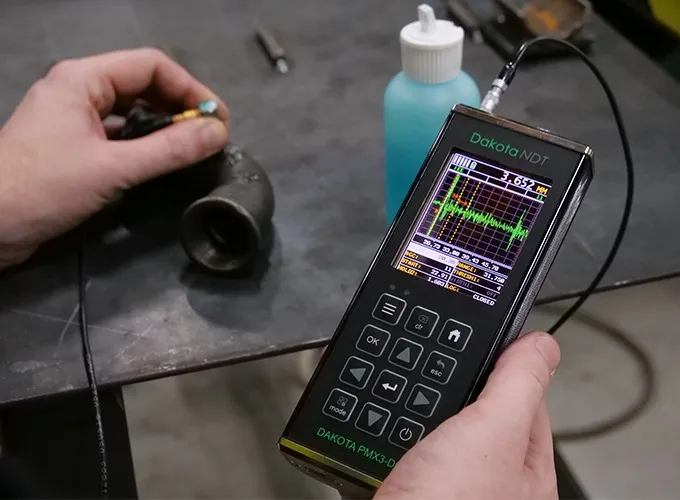
We have created a website entirely dedicated to ultrasonic instruments
The new site offers product data sheets, manuals, certifications, applications and advice on choosing the right instrument

RODER SRL distributes Dakota Ultrasonics instruments in Italy for ultrasonic tension testing of bolts and tie rods. For an introduction to the subject, see our earlier article Systems for elongation and tension testing of bolts and tie rods. This post instead focuses on the technical and regulatory aspects: measuring principle, ASME PCC-1 compliance, choice of instrument and typical industrial applications.
Principle of differential ultrasonic measurement
When a bolt is tightened, it elongates elastically in proportion to the applied axial load (Hooke’s law). On standard industrial bolts the elongation is in the order of hundredths of a millimetre, but it can be measured perfectly with the differential ultrasonic technique:
- The time of flight of an ultrasonic pulse is measured in the unloaded bolt (initial length L₀).
- The bolt is tightened.
- The time of flight is measured again in the tightened bolt (length L₀ + ΔL).
- The difference ΔL/L₀ is proportional to the axial load via the elastic modulus of the material and a calibration coefficient specific to the bolt geometry.
The accuracy of Dakota bolt tension monitors is in the order of 0.0001 mm on the time of flight, which translates into a typical uncertainty of ±2–5% on the axial load — an order of magnitude better than torque control.
ASME PCC-1: the reference standard

ASME PCC-1 (Pressure Boundary Bolted Flange Joint Assembly) is the international reference standard for controlled tightening of bolted flanges in pressure boundaries: heat exchangers, pressure vessels, steam generators and critical piping systems. The standard provides detailed procedures to ensure uniform tightening and an axial load that complies with design specifications, drastically reducing the risk of seepage and leaks.
Appendix K of ASME PCC-1 is dedicated to “Bolt Load Verification using Ultrasonic Measurement” and defines procedures, calibration requirements and acceptance criteria for ultrasonic measurement of bolt load. For a detailed look at the procedure: ASME PCC-1: the reference standard for controlled flange tightening.
Other standards relevant to specific applications:
- ASTM E1736 — standard practice for ultrasonic measurement of bolt axial tension.
- API 6A / API 17D — oil & gas wellhead and subsea applications.
- VDI 2230 — systematic calculation of high-duty bolted joints.
- EN 1591 — calculation of gasketed circular flanges.
When torque control is not enough
Moving from traditional torque control to ultrasonic control is justified — and often mandatory — in situations where the axial load value is critical for safety, reliability or tightness. The main scenarios:
- Critical flanges on pressure vessels — load scatter from bolt to bolt causes seepage, gasket distortion and the need for subsequent re-tightening.
- Large-diameter bolts (M30 and above) — the percentage uncertainty of torque control becomes very high.
- Very long tie rods (turbines, steam generators, industrial gearboxes) — torque cannot be checked because hydraulic tensioners are used.
- Special lubricants, anti-seize compounds, coatings — they change thread friction unpredictably and therefore the torque/load ratio.
- Stainless steel or special alloy bolts — the risk of galling requires very cautious tightening that torque control cannot verify.
- Documentary traceability — when the customer requires the actual load to be recorded (oil & gas, railway, wind, nuclear).
Dakota NDT instruments: BT1-DL and BT2-DL
Dakota produces two instruments dedicated to ultrasonic bolt load measurement; they share the same acquisition electronics and differ in form factor and feature set:
- Dakota BT1-DL (MiniMax) — portable, lightweight, battery-powered tension monitor. It is the typical choice for field measurements directly at the tightening point, on site structures and on in-line pipe flange stacks.
- Dakota BT2-DL (Max II) — top-of-the-range benchtop version, ideal for workshops, test laboratories, pre-tightening stations in production and the initial qualification of bolt batches.
To help you choose between portable and benchtop according to application and workflow, we have published a detailed technical comparison: Dakota BT1-DL vs BT2-DL: portable or benchtop bolt tension monitor?
Dedicated transducers and accessories
For bolt load measurement, Dakota supplies a dedicated line of transducers optimised for contact on the bolt head, even in recessed or hard-to-reach geometries. Available options include:
- Probes with integrated magnet for quick coupling on vertical or overhead surfaces.
- Direct-contact probes with coupling via high-viscosity gel.
- Threaded adapters for bolts with standardised top preparation.
- Shielded cables in lengths suited to tightening in difficult positions.
Good industrial practice is batch qualification: before installation, a few representative bolts are selected, both ends are given a flat, parallel surface preparation, and an individual calibration is carried out by measuring the sound velocity factor of the material. This procedure, provided for in Appendix K of ASME PCC-1, further reduces measurement uncertainty.
Typical application sectors
- Oil & gas and petrochemicals — process pipe flanges, heat exchangers, pressure vessels, separators, critical valves.
- Power generation — turbine closure bolts, steam generators, small boilers, alternators, rotor stack tightening.
- Railway sector — wheelset assemblies, frame and bogie bolts, critical tightening to RFI / RINA / DB / SNCF specifications.
- Wind energy — tower, blade and hub bolts. Mechanical fatigue and load reversal make the initial preload value critical.
- Heavy machinery construction — industrial gearboxes, presses, mills, cement plants.
- Shipbuilding and offshore — structural bolts to RINA, Lloyd’s, ABS and DNV rules.
RODER distribution, support and services
RODER SRL supplies the Dakota BT1-DL and BT2-DL instruments in Italy with NIST-traceable factory calibration, technical support in Italian for defining the measurement procedure, on-site operator training and a certified periodic calibration service. For complex applications — very long tie rods, non-standard geometries, qualification of new batches — a dedicated consultancy service is available to fine-tune the specific procedure.
For technical documentation, product sheets and in-depth regulatory information: www.ultrasuonindt.it.
Related reading:
- On roder.it: Systems for elongation and tension testing of bolts and tie rods
- On ultrasuonindt.it: ASME PCC-1 — the reference standard for flange tightening
- On ultrasuonindt.it: Dakota BT1-DL vs BT2-DL — technical comparison
Contacts & Information
Contact for general information : info@roder.it
Machine Vision Division of RODER : www.rodervision.com
RODER Instruments Division : www.innovacheck.com
More about RODER : about us
The information contained in this website is provided for information purposes only. Although it has been prepared with the greatest care, it does not constitute a contractual offer or a binding commitment to supply. It may contain transcription, translation or typographical errors. For precise and up-to-date information, please contact our company directly.
Note: Some images on this website have been intentionally generated using artificial intelligence (AI). This is because, for many applications and projects, photographs of the actual installation or system cannot be disclosed owing to confidentiality agreements, contractual clauses and non-disclosure agreements (NDAs).
Applicazioni correlate :
 Ultrasonic measuring instruments for thickness measurement
 LASER measuring instruments for laboratory testing with data acquisition software
 Eddy current systems for integrity testing of discrete and continuous mechanical parts
 Systems for testing the adhesion strength of paints, enamels and adhesive tapes
You must be logged in to post a comment.