





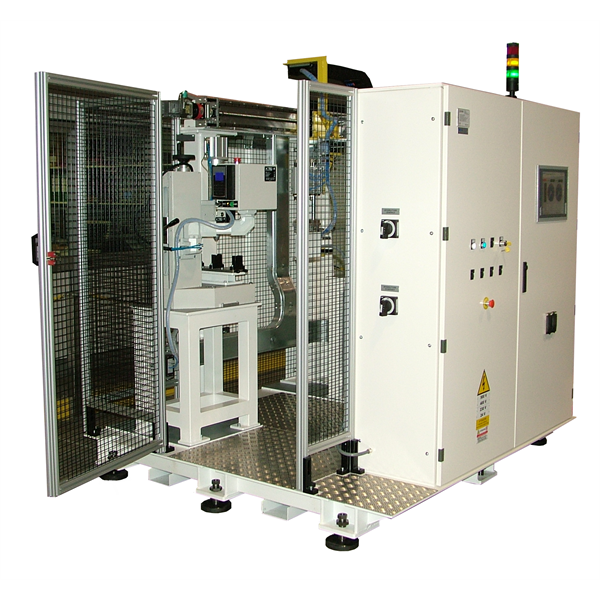
Robotic inspection cells are a technologically advanced solution for testing the hardness of materials, combining robotics and automated measuring instruments. Thanks to the use of automatic hardness testers, these cells optimise inspection processes, ensuring precise results that comply with the most demanding industrial standards.
What is automatic hardness testing
Hardness testing is a fundamental measurement for assessing the resistance of materials to plastic deformation. This process is essential in sectors such as automotive, aerospace and mechanical production, where material quality directly affects the performance of the final product.
How robotic cells work
Robotic cells are fully automated systems that combine robotic arms with hardness testers. The latter are instruments capable of measuring hardness quickly and precisely, using different scales such as Rockwell, Vickers or Brinell.
- Automatic loading: robots pick samples from the production line or a storage system.
- Precise positioning: the robotic arm places the sample on the hardness tester.
- Test execution: the hardness tester performs the measurement according to predefined parameters.
- Data management: results are collected and analysed automatically, integrating with the company’s management system.
Main components
- Robotic arms: ensure precise movements and sample handling.
- Automatic hardness testers: measure hardness using advanced technologies.
- Control software: coordinates the process and analyses the results.
- Vision systems: verify correct positioning of samples.
Advantages of robotic cells
- Full automation: reduces human intervention, increasing productivity.
- Precision and repeatability: minimises errors, ensuring reliable results.
- Operational efficiency: allows continuous testing, including unattended operation.
- Traceability: records and archives data for future analysis and regulatory compliance.
Types of hardness testers used
- Rockwell: ideal for metallic materials.
- Brinell: used for testing materials with non-uniform surfaces.
- Vickers: for measurements on thin materials or small samples.
Industrial applications
Robotic cells are used in various sectors:
- Automotive: inspection of critical components such as gears and bearings.
- Aerospace: testing of high-performance materials.
- Tool manufacturing: analysis of metals and alloys used for precision tools.
Customisation of the cells
Each cell can be configured to meet the specific needs of the company. Robotic arms can be adapted, several hardness testers integrated and dedicated software used for advanced analysis.
Reference standards
Hardness tests must comply with international standards such as ISO 6508 (Rockwell) or ISO 6507 (Vickers).
Integration with Industry 4.0
Robotic cells integrate easily into digitalised factory systems, improving connectivity between machines and facilitating data collection for predictive analysis.
Technological innovations
Integration with artificial intelligence and machine learning makes it possible to optimise processes, identifying anomalies in the results and suggesting corrective actions.
Conclusion
Robotic inspection cells with automatic hardness testers are an indispensable solution for companies focused on quality, efficiency and innovation. They automate hardness testing, ensuring compliance with standards and optimised management of production processes.

Would you like help choosing the right product ?
Copyright by RODER SRL – Oglianico (TO) – Italy
Website: www.roder.it
Machine vision division: www.rodervision.com
Measuring instruments division: www.innovacheck.com
Applicazioni correlate :
 Robotised inspection cells for automatic inspection of diameters and ovality on pistons and cylinder liners
 Robotic cells for quality control with machine vision systems
 Automatic inspection cells for measuring the diameter and ovality of parts produced on machining centres
 Automatic systems for dimensional inspection of parts machined on CNC machining centres
 Automatic fixtures for dimensional and geometric inspection with LVDT contact probes
You must be logged in to post a comment.